









We are hearing more and more about initiatives related to electromobility in Poland. How can we assess the progress in this area? What are the prospects for the development of e-mobility in Poland?
 Jana Pieriegud, Associate Professor at the Department of Transport at the Warsaw School of Economics, independent expert for the European Commission: The fact that interest in implementing e-mobility solutions in Poland is constantly growing is evidenced, among other things, by the large number of conferences held this summer and autumn in various Polish cities. However, discussions and initiatives related to the technical and technological aspects of developing the e-mobility concept dominate. This concept includes the development of energy storage technologies and the widespread adoption of electric vehicles (electromobility), including battery electric vehicles (BEV), hybrids, and those using hydrogen fuel cells. In visions of the future, vehicle traffic management and control will increasingly rely on digital technologies (connected mobility), as well as a higher degree of traffic automation, including fully autonomous mobility. New solutions will be implemented alongside rail transport modes used since the late 19th century: trains, trams, subways, and trolleybuses, which use electric traction. It is also assumed that the functioning of e-mobility systems will be based on values characterizing the sharing economy or circular economy concepts, which enable the popularization of new business models such as: shared mobility, mobility on demand, and Mobility as a Service (MaaS).
According to the assumptions of the Plan for the Development of Electromobility in Poland “Energy for the Future,” adopted by the Council of Ministers of the Republic of Poland on March 16, 2017, battery electric vehicles (BEV), used in models such as car-sharing and integrated with smart grids, are intended to be important elements of urban transport systems in the future. Achieving the goals set out in this document will undoubtedly be an extremely difficult task, given that although electric car drives have been refined over the past 135 years, they have not found widespread use in transport systems. At the beginning of 2017, the share of BEV electric cars both globally and in Europe was below 1% of the entire passenger car fleet. Even according to the most optimistic modern forecasts, a 30% market share will not be achieved by 2035.
Trends that will be visible in the future on the global market do not have to be immediately felt on the Polish market. This is because the Polish automotive market is at a stage of development observed in most countries with relatively low household incomes. Poland is at the very beginning of a long road to e-mobility. So far, the greatest progress in Poland has been achieved in starting the operation of e-buses, the first car-sharing systems have appeared in several cities, and new fast-charging stations for electric vehicles are being built. In the coming years, we can expect the popularization of electric bicycles (e-bikes).
However, it must be emphasized that the implementation of the e-mobility concept is a systemic undertaking requiring the cooperation of many stakeholders. For the e-mobility concept to become a reality, radical changes must occur in at least five interrelated areas, which I call the “golden pentagon of e-mobility”:
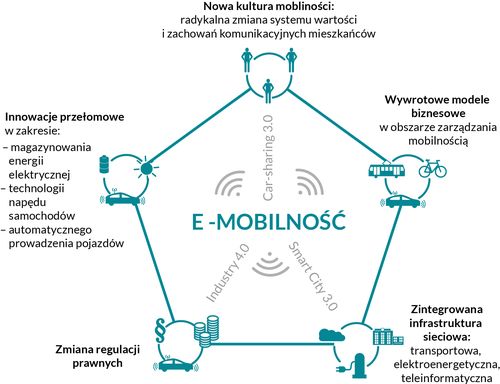
Apart from breakthrough technological innovations and disruptive business models, the greatest challenge in the process of popularizing e-mobility should be considered the creation of a new culture of mobility. Especially in the case of Poland – as a country where the development of motorization was significantly delayed compared to many other European countries, and the share of private car travel in cities continues to grow – the lack of changes in residents’ transport preferences may constitute a significant barrier to the implementation of the e-mobility concept.
I encourage you to read the monograph “E-mobility: visions and development scenarios”, which was published as part of the “European Financial Congress Publications” series. An interdisciplinary team of authors took on the challenge of systematizing knowledge about e-mobility and presenting both global visions and concepts, as well as the prospects and barriers to the development of e-mobility in Poland.