









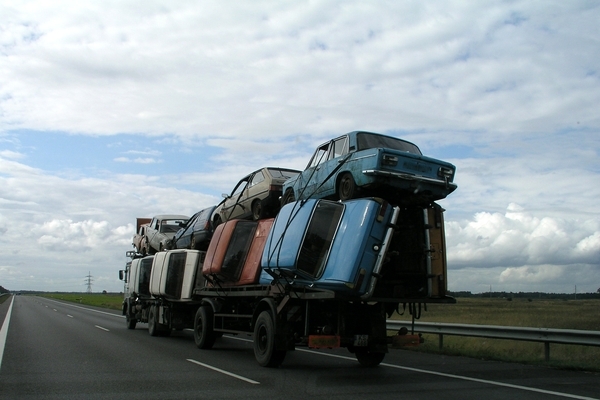
One of the main areas posing a significant threat to the environment is the continuous increase in the number of vehicles in operation in the country. A very significant portion of them is used in small urban agglomerations and in rural areas. Furthermore, the vehicles operated there are used over a long period, exceeding 15 years or more, and very often their technical condition is unsatisfactory.
Due to environmental concerns, high fuel consumption (older generation vehicles), and a technical condition that leaves much to be desired, these vehicles should be withdrawn from use. This applies to several million vehicles. One-third of registered vehicles are used (operate) in agriculture. Old, worn-out agricultural machinery is also used in rural areas. Agricultural tractors account for almost 7% of all registered vehicles, and their average age of use is over 20 years. These machines and equipment will also be withdrawn from service. A problem arises regarding the collection of vehicles and machinery from particularly rural, territorially dispersed areas. For economic reasons (costs related to logistics and organization), a rational distribution of facilities accepting end-of-life vehicles, machinery, and scrap is needed.
Proper management of end-of-life vehicles, machinery, components, parts, and consumables is also supported by the increasing costs of extracting energy resources and materials. Increased production leads to a higher demand for raw materials and the necessity for increased extraction. Mineral deposits are closer to depletion, and their extraction is becoming increasingly expensive. There is a possibility of reusing them through processing. Some of them can be recovered from old machines. Used motor vehicles contain about 70% high-quality steel and non-ferrous metals. The principle of reusing materials and components of cars has become a necessity in the face of the growing environmental threat. Reusing parts and materials from end-of-life vehicles requires the development of a comprehensive action program that takes into account environmental protection and the acquisition of materials and energy resources. Costs will determine the profitability of recycling here. One of the elements of this system is the rational distribution of collection points for end-of-life vehicles and machinery, as well as processing plants. Developing a methodology for the location of not only recycling plants but also service facilities allows for the reduction of logistics costs for managing waste products, post-production waste, or service operations. This is related to the costs of environmental degradation, organization, transport, and storage. The recycling network should be designed in rural areas and small agglomerations. Rural areas have many advantages for building service facilities away from large agglomerations, such as: lower land and property prices, lack of nuisance due to proximity to residential areas, easier access for heavy goods vehicles and tractor units, and the high territorial dispersion of used vehicles compared to urban clusters.
The project for recycling vehicles and agricultural machinery in Poland has not been widely implemented due to a lack of interest in this type of activity and a limited number of facilities capable of recycling. A solution to this problem could be a system supporting the planning of locations for vehicle dismantling stations and waste product collection in a selected area.
The article contains 22,760 characters.
Source: Logistyka Magazine
135_Winiczenko_Trajer_Golisz_Golebiewski_Analiza_sieci_recyklingu_pojazdow.pdf