









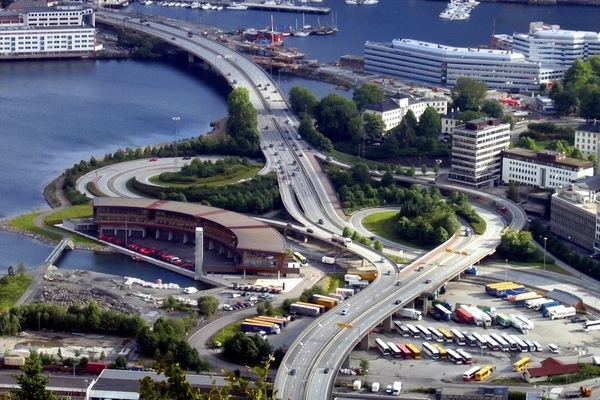
The 20th century was a time of significant changes in the functioning of urban organisms. Urban structures, often shaped in earlier times, became a space of very intense transformations in the 20th century, associated with an increase in the number of processes carried out in the urban space.
The multitude of residents, business entities, and institutions generating flows, both of people and cargo, can lead to a multidimensional conflict of interests, causing harm to all stakeholders. As a result, the urban space may lose its unique, multifunctional character, leading to the degradation of the city, a decline in its attractiveness, and its development potential. Managing the flows of cargo and people thus becomes one of the key activities for maintaining an appropriate level of functionality of the urban space, undertaken by municipal authorities and, increasingly, by the entities participating in these processes themselves.
The article presents selected strategies and elements of flow management implemented by cities. Due to the key importance of both city transport strategies for TSL industry stakeholders and the influence of these stakeholders on the functioning of urban logistics, the aim of the article is to analyze the consequences of strategies and solutions adopted by cities for transport service providers.
Some developed cities, where awareness of the complexity of flow management issues, as well as organizational and financial capabilities, are at a high level, have long been effectively managing the flows of goods and people. Although the solutions presented in the paper are very heterogeneous, they have been successful in every case, improving the quality of the urban space and the implementation of logistics processes. Due to the diversity of the analyzed solutions, theoretical issues, and documented practice content, the article is not divided into two separate parts, as is the case in customary research work. Theoretical and practical elements refer to each of the solutions separately.
Toll – a cost-based traffic management tool
Until the 19th century, the concept of a toll functioned in Poland as, among other things, a fee charged for entering cities; today, this concept is returning in a very similar form. Cities such as Singapore, Oslo, and London have decided to introduce charges for entering their centers; Singapore was the precursor, initiating the project in 1975. The main reason for introducing these solutions in the case of both Singapore and London was the problem of excessive traffic congestion. The authorities of the latter city decided on such a solution in order to obtain funds for the construction of bypasses.
Singapore began the project by introducing fees charged for entering the center in the form of pre-purchased “tickets,” which were required during the morning and evening rush hours. Over time, it developed the project both in terms of operating rules and applied technologies, the consequence of which is the dynamic system functioning today that collects fees based on readings from RFID transmitters placed in vehicles. The effect of this solution was a significant reduction in traffic intensity and a doubling of speed in the downtown zone.
The article contains 23,450 characters.
Source: Logistyka Magazine