









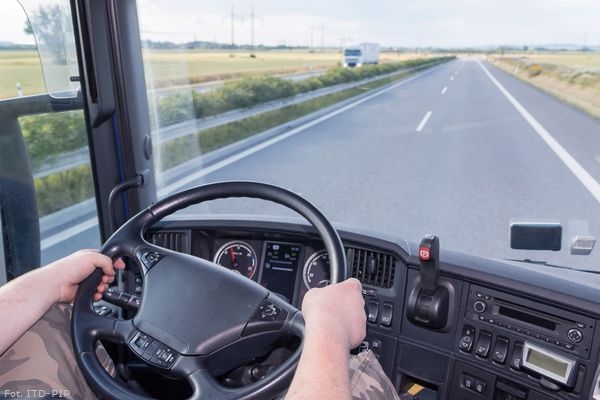
They drive “to the limit”, from loading to unloading. They spend hours looking for a parking space or waiting for loading. They take longer breaks when it is not necessary, and then half an hour before their destination, they have to pull into a parking lot. How to plan drivers’ driving and rest time so that their work is efficient? Legal regulations and modern technologies come to the rescue.
Use the regulations
Ignorance of the law is harmful, and in the case of settling drivers’ working time, it simply does not pay off. A transport company owner must know the regulations inside out.
– For example: if we know that a driver’s driving time can be extended from 9 to 10 hours twice a week, we will plan the route much more flexibly and use the driving time in full – notes Tomasz Szerszeń from the ITD-PIP transport law firm. – Let me give another example: few people know that the daily rest period can be reduced from 11 to 9 hours three times after each weekly rest period, and not just three times in one week. If we are familiar with the regulations and can interpret them correctly, we can save quite a lot of drivers’ working time completely legally.
Act in real time
A driver on the road is not always able to correctly analyze their working time and determine when and which sections of the route they can cover.
– It happens that they take longer breaks when they could easily drive, and then half an hour before the destination, they have to pull into a parking lot in accordance with the regulations. Such situations can be avoided. The key is, of course, the ability to operate digital tachographs, which have extensive functions. However, it is also worth using other modern technologies that support the driver’s work – emphasizes Tomasz Szerszeń.
Carriers are increasingly providing drivers with IT solutions, the primary task of which is to effectively settle working time, but they also help to efficiently and promptly resolve such doubts. Among the latest IT solutions for the transport industry is, among others, TachoDroid – the first and most popular smartphone application in Poland that functions as a reader for digital tachographs and driver cards.
– Reading a card takes only a few seconds, and a full tachograph reading takes a few minutes. Thanks to the application, the driver can send information online to their company at any time, which allows them to immediately clarify how much longer they can drive – says Tomasz Szerszeń.
It is worth keeping up with new developments, because progress in this field is extremely fast. For example, there are applications that calculate the time remaining to the unloading point and automatically send information to the shipping warehouse well in advance. Thanks to this, unloading can be organized more efficiently, and the driver loses less time waiting. The use of such solutions on a wider scale is still a thing of the future, but there are many indications that it is not far off.
Plan where to drive, where to eat and rest
Of course, not everything can be predicted on the road, especially considering the fact that traffic on European roads is constantly increasing. Meanwhile, road infrastructure is not developing fast enough, and this applies not only to Poland. In Germany, in 2015, there was a shortage of about 30,000 parking spaces for trucks.
– There is no current data on this subject yet, but it is clear to the naked eye that the problem is growing. On Friday evenings, drivers stop in dangerous places at motorway exits, often already on the hard shoulder, or are forced to look for a parking space somewhere further away from the route – notes the ITD-PIP expert.
– The regulations give the driver some possibility to extend working time in a situation where safety is at stake. You then have to make an appropriate annotation on the tachograph printout, and if the procedure is carried out correctly, there are no financial consequences. However, the time that the driver loses looking for a space cannot be made up. If they started their rest 30 minutes later, they will also start their further journey with such a delay – explains Tomasz Szerszeń.
Modern location systems allow for very precise planning and flexible modification of the route. It is worth considering not only the costs associated with road tolls and the length of alternative routes, but also traffic intensity on individual sections, on specific days and at different times, as well as the availability of rest areas with appropriate catering and sanitary infrastructure, which are safe and allow for refueling.
– It is no coincidence that more and more drivers are using “parking” applications, recommending rest areas to each other. Such an analysis, combined with the skillful use of the possibilities provided by working time regulations, allows for optimal route planning, saving not only time but also the nerves and health of drivers – concludes Tomasz Szerszeń.