









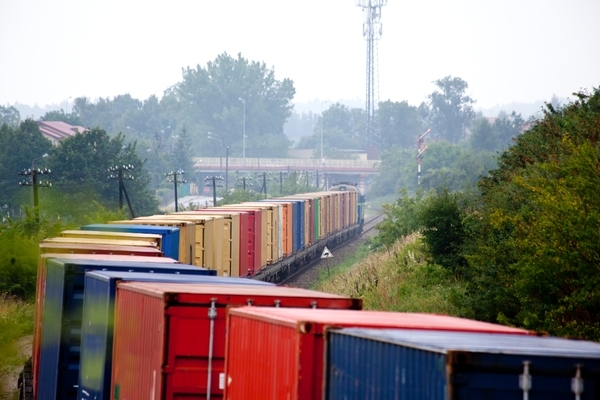
For the first time in many years, the average commercial speed of freight trains has increased. In 2016, it reached approximately 25 km/h. This growth is encouraging, but there is still much to be done to achieve speeds as high as those in some European Union countries.
Between 2010 and 2012, the average commercial speed exceeded 25 km/h. In the years 2013-2015, it dropped significantly due to the accumulation of modernization works on the railway network. Many investments financed from the European Union budget for 2007-2013 were implemented with delays, which meant their peak coincided with the settlement period of the previous perspective. In 2016, most of the renovation work on the tracks had already been completed, which translated into improved operating conditions for carriers. Intermodal transport, which is generally characterized by higher speeds, also increased significantly.
In the opinion of the President of the Office of Rail Transportation (UTK), the average commercial speed in Poland is still very low and negatively affects the competitiveness of rail transport. In Germany, it is more than twice as high as in Poland. Recently, modernization works have started on the Polish network as part of the 2014-2020 EU perspective, with a settlement period until 2023. The works are to cover lines important from the point of view of freight traffic, including the Oder trunk line, other access lines to ports, lines in Silesia, as well as bottlenecks requiring point investments. There is, therefore, a chance that in the coming years, and especially after the completion of the current perspective, there will be an improvement in the average speed of freight transport. However, the accumulation of investments planned for the years 2019-2021 is a threat, which is why it is important to prepare detour routes and better organize the work.
The President of the UTK emphasizes that the low commercial speed in Poland results not only from low permissible speeds on the lines but also from long train stops. It is therefore important that, as part of the ongoing investments, both the permissible speed and the capacity of the railway network are increased (reconstruction and construction of additional tracks, passing loops, elimination of bottlenecks and point speed restrictions). Such a comprehensive approach is necessary to increase the competitiveness of the railway.
To calculate the average commercial speed, a methodology was used according to which the commercial speed is the quotient of the distance between the starting and ending point of the route (in kilometers) and the time in which this route was traveled (in hours). The average annual commercial speed provided by individual carriers was indexed by their market share measured by the transport work performed.
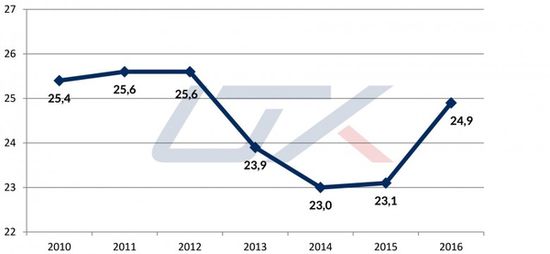
Source: UTK