








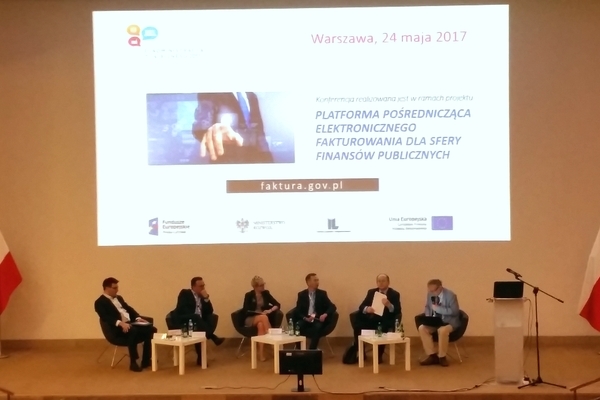
The E-Administration for Business conference gathered over 200 participants interested in the implementation of electronic invoicing in the public finance sector. During the debate organized in the plenary session, discussions focused on opportunities and threats, the need for cooperation between government units and local governments, and overcoming mental barriers regarding the use of e-invoices. Subsequent presentations included, among others, plans for implementing e-invoicing in Poland and best practices from other countries.
In the second part of the meeting, thematic presentations were held regarding the near future of invoicing in Poland, and the point of view of public institutions on the mentioned issues was also presented.
The concept of transforming the traditional paper-based form of invoicing into a fully electronic form is set for the year 2020. By that time, two changes will be gradually introduced – the obligation to accept electronic invoices and the obligation to issue invoices in electronic form. The introduction of these changes will be supported by the Ministry of Development so that the public entities affected by the change can adopt it smoothly, incurring as few costs as possible. During the session, the assumptions and the roadmap to achieving the goal of a completely electronic form of invoicing were presented.
The introduction of the obligation for electronic invoicing in public procurement means imposing on public entities the duty to execute the provisions of the Act on Electronic Invoicing in Public Procurement. This obligation has a legal dimension, but from the point of view of the reality in which Polish public entities operate, the main challenge lies in the implementation aspects. The ability to implement new regulations depends primarily on the technical capabilities of public entities to receive e-invoices compliant with the European standard. These capabilities determine the implementation of appropriate procedures for receiving and processing electronic invoices for public procurement, and thus determine the achievement of the expected benefits from the implementation of the new regulations. In this thematic session, the speakers presented the point of view of representatives of public institutions.
The conference was organized by the Institute of Logistics and Warehousing and the Ministry of Development. More information on the Conference website.