








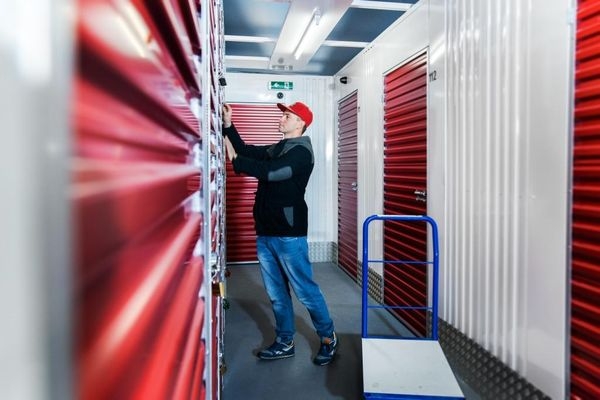
Storing items in “hotels for things,” as self-storage facilities are often called, is becoming increasingly popular among the residents of Silesia and the Zagłębie region.
A young Silesian and Zagłębie market
Instead of using a basement, attic, or garage, residents of Silesia and the Zagłębie region are increasingly choosing to store their belongings in special self-storage facilities. Today, there are already 3 such places operating in the region, and 11 across Poland. In terms of the number of warehouses, the Silesian Voivodeship currently ranks 4th in the country.
– The self-storage market in Poland and the Silesian Voivodeship is very young. In Silesia and the Zagłębie region, only the last 2 years have brought its quite dynamic development, associated with the construction of new halls. Their appearance is the result of growing interest from regional residents in renting this type of space as a safer alternative to a basement or garage – argues Aleksandra Suwała, a representative of Sejfboksy from Sosnowiec.
How great this need is, is best shown by the example of the Sosnowiec Sejfboksy. This is the latest investment of this type in the region, launched at the end of December 2016. On 1,200 square meters, 120 modern boxes were created, ranging from 1 cubic meter to 10 square meters. In just 3 months since opening, over 30% of them have been rented.
– This is our second investment of this type in Sosnowiec. The first warehouses, operating since 2010 and having 25 boxes, are almost constantly 100% rented. The new warehouse filled up by one-third in just 3 months. If the interest continues, we have plans to expand the current investment. The hall we own gives us such possibilities – says Jarosław Nowakowski, General Director of the AMTRA company, which owns Sejfboksy.
Housing estates are escaping to boxes
Today, interest in renting warehouses comes primarily from residents of large Silesian and Zagłębie cities, mainly: Katowice, Sosnowiec, Będzin, Dąbrowa Górnicza, and Czeladź. Nearly 60% of tenants are currently individual customers. About 40% are small, local companies, most of which conduct online sales and treat the warehouses as their logistics base.
– Warehouses are mainly rented by people who have too little space in their apartments. These are mostly residents of large housing estates, but also residents of new apartment buildings where developers did not create basements, attics, or storage lockers. The lack of additional space at home is currently the most common reason why we rent boxes. It applies to almost 90% of all individual customer rentals – says Aleksandra Suwała.
It is no wonder, then, that the most popular are small and relatively cheap storage units ranging from 1 to 3 square meters, which customers most often organize in a similar way to storage lockers or utility rooms, keeping in them, among other things, seasonal sports equipment, unused furniture, household appliances, or clothes. Meanwhile, medium and large boxes, ranging from 5 to 10 square meters, are gaining popularity. The latter are chosen primarily by residents of the region looking for a safer alternative to a garage, e.g., for motorcycles, quads, or bicycles. Interestingly, despite the fact that self-storage is a new phenomenon in Poland, customers are increasingly opting for long-term rentals. According to Sejfboksy data, boxes are most often rented for a period of 3 to 6 months. This rental period is chosen by 25% of customers. 20% rent for a period longer than a year. 8% choose a rental of up to 3 months.
– The time for which warehouses are rented depends on the needs. A large group of clients from Silesia and the Zagłębie region decides on short-term rentals of 1 to 6 months, storing seasonal items such as clothes, garden furniture, skis, or bicycles. Clients choosing long-term rentals, usually over 6 months and even up to 2 years, treat their box as a permanent, additional space that was missing in their house or apartment. These are most often people who do not have basements, attics, or storage lockers at home – says the Sejfboksy representative.
Great market potential
Self-storage facilities are causing a real sensation all over the world today. Across Europe, there are already 2,746 such facilities in operation. Their total area is over 7.77 million square meters. In the last year alone, another 149 facilities were launched in Europe – reports FEDESSA. The most warehouses are in Germany, Spain, France, Sweden, the Netherlands, and the United Kingdom. Poland, alongside Hungary, is one of the most dynamically developing markets in Central and Eastern Europe.
– Poland is performing better and better compared to the rest of Europe. The Silesian Voivodeship also has something to boast about compared to other regions in Poland. However, the market’s best years are still ahead of it. Given how interest in renting is growing, we can expect that in the next 5 years, more warehouses will be built in the region, especially on the outskirts of large Silesian and Zagłębie cities, along exit routes, and in the vicinity of large residential clusters – says Jarosław Nowakowski.
What are self-storage facilities?
The fashion for warehouses came to Poland and Europe from the United States. Overseas, the first such investment was created over 70 years ago. Self-storage facilities, also called “self-storage” or “hotels for things,” are nothing more than special, padlock-secured boxes placed in spacious halls that can be rented and arranged as desired. The tenant has access to the box 24 hours a day, 7 days a week, operating the storage unit independently.