









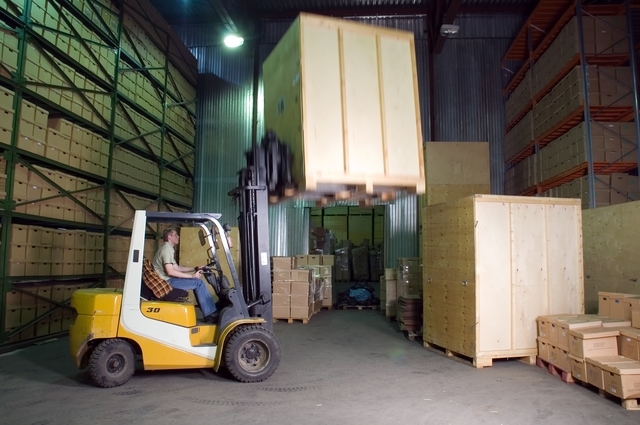
The issue of arranging packaging units (unit, collective, or transport packaging along with their contents) in loading spaces is one of the significant conditions for the rationalization of logistics processes. On one hand, the proper arrangement of packaging units should guarantee maximum utilization of the dimensions and load capacity of the loading spaces, while on the other, it must not lead to damage to the cargo (e.g., as a result of pressure exerted by other packaging units).
Maximizing the utilization of available load unit space has a direct impact on efficiency and the reduction of transport costs (better utilization of transport vehicle capacity, reduction in the number of loading cycles) as well as storage costs (reduction of space required for storage). Research [11] shows that the optimization of load units allows for a reduction of over 1% in supply chain costs compared to so-called rational solutions. In the case of forming heterogeneous load units, the scale of benefits achieved can be significantly greater. The problem addressed in the article occurs in all manufacturing and logistics enterprises, although in optimization models formulated for these systems, it is often assumed that the technology for forming load units is known (cf. among others [7] or [16]). Products created in industrial plants are packed into unit, collective, and transport packaging. Often, the final stage of the production process is also the formation of load units from homogeneous packaging units. In this case, a one-time solution to the problem can be used for a long period, so it can be obtained using expert methods or exact optimization methods. In logistics enterprises, the problem of forming load units is much more complex. There is a need here to obtain solutions in real-time for diverse packaging units forming heterogeneous load units. Existing optimization methods that can support the formation of load units are known in the literature [4], [10], [12], [13] as the two-dimensional and three-dimensional loading problem. As shown in the next chapter of the article, the optimization tasks for cargo unit placement developed so far have been obtained while taking into account certain usually overly strong simplifying assumptions. These assumptions mean that the solutions to these optimization tasks cannot always have a correct physical interpretation. With this in mind, work has been undertaken on a general formulation of the optimization task for forming load units.
The article contains 24,210 characters.
Source: Logistyka Magazine
Popiela_Wasiak_Optymalizacja_formowania_jednostek_ladunkowych.pdf