









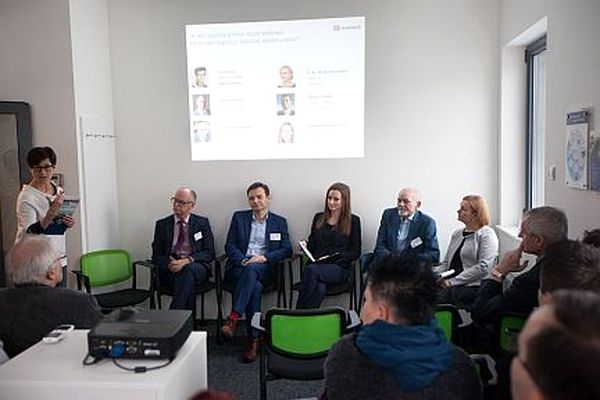
The new DB Schenker logistics terminal in Zielona Góra hosted company clients, representatives of local authorities and institutions, as well as universities. It was an opportunity to discuss business cooperation with the surrounding environment. Meeting participants were also able to see what daily work looks like in an ecological cross-docking terminal.
On January 24th, DB Schenker hosted its clients from the Lubusz region and local leaders from Zielona Góra. The investment was also appreciated by the city authorities, represented by Dariusz Lesicki, Deputy Mayor of Zielona Góra.
– We operate in accordance with our sustainable development strategy. By taking care of the quality of solutions offered to our clients, we are constantly improving our processes and focusing on even better, ecological resource utilization. This is a key element of the Lean culture we are building in our company – said Janusz Górski, CEO of DB Schenker North & East Europe.
An important part of the meeting was a discussion panel led by Prof. Halina Brdulak from the Warsaw School of Economics. The invited speakers discussed the possibilities of business influence on the development of the local community, exchanging their experiences in this regard. During the panel, representatives of city authorities, business, and academia took the floor. The guests pondered how business can influence the development of the local community. The panelists emphasized that trust, openness to sharing knowledge, and an attitude of co-responsibility are extremely important, both on the part of local authorities, academia, and business. In such an atmosphere, there is a chance to create ideas that realistically build and multiply social capital. Knowledge transfer is needed, but it must also be accompanied by concrete practical experience, e.g., academics and students should have the chance to see how business functions on a daily basis. The meeting was therefore a valuable inspiration and also created an opportunity for future joint actions for the local environment.
Participants also had the opportunity to tour the new terminal and learn about daily logistics operations, which result in goods from various industries reaching store shelves and production lines from day to day. The meeting was an opportunity to discuss the development of the region and the local community, as well as to take a look at the daily work of the terminal.
The modern, ergonomic terminal of the DB Schenker branch in Zielona Góra, located at the newly built Stary Kisielin – Logistyczna street, is situated near the S3 expressway. The total area of the plot, including the parking lot for trucks, is over 27,000 square meters. The terminal area is 2,000 square meters, and the office and social area for employees and drivers is 370 square meters. The facility is an important element in the national and European distribution network of DB Schenker. It influences the quality and efficiency of logistics operations as well as the safety of people and shipments. The change of the terminal’s location from the city center to its outskirts results from DB Schenker’s sustainable development strategy regarding economic, as well as social and environmental goals. Relocating the facility will contribute to reducing air pollution in Zielona Góra, decreasing traffic intensity, and lowering noise levels.
In the near future, the DB Schenker terminal in Zielona Góra will undergo an audit as part of the BREEAM (British Research Establishment Environmental Assessment Method) certification. The BREEAM certificate confirms a high degree of advancement in terms of ecological solutions used in the facility and user comfort. The terminal meets the highest standards in terms of energy saving, CO2 emission reduction, and efficient water and heat management. These include LED and solar lamps, solar collectors for heating utility water, rainwater tanks, and heating and ventilation units that allow for heat recovery. Special condensing boilers are the most ecological solutions of this type on the market.
DB Schenker’s investments in a green network of cross-docking terminals in Poland are an action in line with the corporate DB2020 strategy, under which the operator has set a goal to reduce CO2 emissions by 30% by 2020. In 2016 alone, DB Schenker in Poland invested over 34 million PLN in new green terminals and other pro-ecological solutions.
There are already three fully ecological terminals operating in the DB Schenker network: a facility near Białystok commissioned in 2014 – the first building of this type in Poland with a BREEAM certificate, and twin investments near Olsztyn and Zielona Góra, commissioned in November 2016.
All three terminals have been located away from city centers. In recent years, DB Schenker has also moved its terminal locations in the Kraków and Gdynia branches to the outskirts of cities. The company is planning further such investments.