









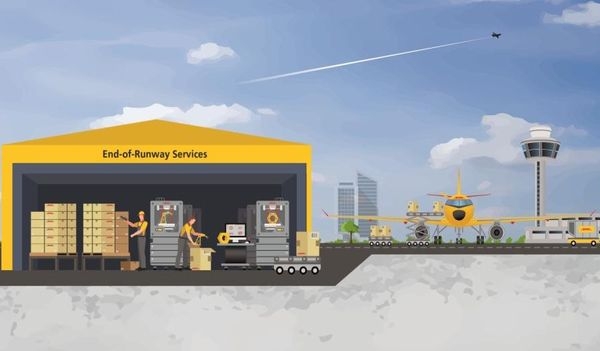
Logistics service provider DHL has released its latest DHL Trend Report – 3D Printing and the Future of Supply Chains. For several years, DHL has been testing various 3D printing equipment and techniques, which has enabled it to identify applications with the potential to redefine production and supply chain strategies. While the 3D printing market is estimated to grow to 180-490 billion US dollars by 2025, according to this report, 3D printing will not replace mass production, but will become a complementary process.
– The DHL Trend Report “3D Printing and the Future of Supply Chains” identifies 3D printing as a transformative technology. However, it is not a silver bullet that will make mass factory production and industrial manufacturing obsolete. The exciting potential of 3D printing lies rather in the ability to simplify the production of highly complex and custom-made products and spare parts – this could bring logistics and industrial manufacturing closer together than ever before in history – said Matthias Heutger, Senior Vice President, DHL Customer Solutions & Innovation.
Redefining supply chain strategies
Also known as additive manufacturing technology, 3D printing technology involves manufacturing products by spraying layers of hot plastic or metal using a 3D printer nozzle onto a pad to create a three-dimensional object, which could potentially lead to replacing processes such as forging and molding at a fraction of the standard costs. This could lead to improved product quality, the manufacturing of multiple products by a single printer, new types of products, as well as new supply chain strategies and models.
The technology has found application worldwide across many industrial sectors: aerospace, engineering, automotive, and healthcare. Mercedes Benz Trucks has launched a 3D-printed spare parts service, while in the healthcare sector, this technology, combined with a scanner, enables the creation of customized external and internal elements used for purposes ranging from prosthetics to dental crowns. It is also used for independent production in remote environments – a highly sought-after service by mining companies, space agencies, and the military for manufacturing critical spare parts.
Complementary technology
Current factors limiting the more widespread adoption of 3D printing technology, since around 1980, include a lack of knowledge in management, economic, and technological issues. Many printers can only work with one specific material, and costs remain high for advanced industrial-grade 3D printers. In the face of warranty, liability, and intellectual property issues, 3D printing must become faster and more advanced before it becomes a core production technology.
– Not all products should, can, or will be 3D printed. However, encouraged by the possibilities of greater personalization, less waste, and more localized production and delivery, companies in many industries are showing growing interest in using 3D printing technology. Recent studies have shown that 38 percent of companies intend to use 3D printing technology in series production within the next five years, but not necessarily to completely replace traditional production. We believe that 3D printing technology will have a major impact in the medium term on spare parts logistics and the production of customized parts – said Markus Kückelhaus, Vice President of Innovation and Trend Research, DHL Customer Solutions & Innovation.
Greatest impact on spare parts logistics
The DHL Trend Report “3D Printing and the Future of Supply Chains” highlights the opportunities for companies to collaborate with logistics service providers offering 3D printing. These areas include “on-demand spare parts” – a model that can reduce mass storage costs, “end-of-life services” for the rapid production of time-sensitive parts, and “product postponement” to increase customization options while simultaneously reducing lead times to the customer.
Direct customized part production and product postponement, in both cases on customer demand for customized products, allow for production and assembly. These are divided into stages performed by regional or locally located printers involved in final production; this requires entirely new supply chain strategies.
The main goal for end-of-life services is sector-specific service offerings and integrated return and repair services; printing can be used here to enable rapid production and shipping of parts. This would be invaluable for the energy, engineering, and manufacturing sectors – and could also improve warranty repair issues in the consumer sector. On-demand spare parts can involve logistics companies in the supply chain in a new, revolutionary way by printing parts “on the go” while delivering them to the customer.
– As manufacturers adjust their production processes, it is possible to create new opportunities and challenges in the supply chain. At DHL, we look forward to working with customers and partners to jointly discover new solutions and unlock the potential of 3D printing and integrate it into logistics and future supply chains – added Matthias Heutger.
DHL, which has already tested temporary 3D printing facilities, recommends that companies involve their logistics partners in the 3D technology “journey,” directly from the assessment and analysis stage, to maximizing the potential benefits in the form of increased high-quality operational activities and savings that this technology can contribute to.