









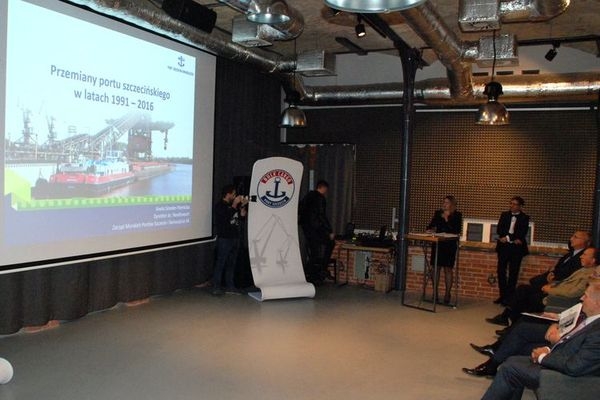
On October 13th, the Szczecin bulk cargo port celebrated its 100th anniversary. The event was accompanied by the 25th anniversary of the Bulk Cargo – Port Szczecin company.
The ceremony took place at the “Stara Rzeźnia” (Old Slaughterhouse) in the Szczecin port. There were commemorative speeches along with wishes for many more years of success. These were delivered by invited guests, including the Mayor of Szczecin, Piotr Krzystek, and Member of the Polish Parliament, Artur Szałabawka. A letter addressed to the jubilarian from the West Pomeranian Voivode, Krzysztof Kozłowski, was read. The meeting was also an excellent opportunity to present the investment plans of the Szczecin and Świnoujście Seaports Authority SA and the systemic changes in Polish ports that have taken place over the last two decades. Additionally, the celebrations were accompanied by an exhibition titled “100 years of the bulk cargo handling area – the Mining Basin and 15 years of Bulk Cargo – Port Szczecin Sp. z o.o.” with commentary by Roman Czejarek and Jan Dębski.
How it began
Work on creating a bulk cargo port in the Szczecin port began in 1916. It lasted 10 years, until 1926. The port itself, dedicated primarily to coal and ore handling in the Mining Basin area in Szczecin, was launched on April 1, 1919. The entire bulk port was handed over for operation on September 1, 1920. The annual handling capacity of the new port at that time was 180,000 tons.
An important year in the port’s history was 1924, when, thanks to the deepening of the fairway connecting Świnoujście and Szczecin, the port could handle ships with a capacity of 10,000 tons. Until the outbreak of World War II, Szczecin had regular connections with 33 Baltic Sea ports and 12 North Sea ports. A turning point in the port’s history was the handover of the Snop, Huk, Kra, Ucho, Mak, Oko, Cal, Drab, and Comet quays by the Soviet administration to the Polish maritime administration in 1946. In turn, the takeover of the entire port area by the Polish administration took place almost a decade later, in May 1954. Three years later, in 1957, the Świnoujście-Szczecin fairway was deepened. Thanks to this, ships with a draft of 8.68 m, a length of up to 140 m, and a width of up to 20 m could enter the Mining Basin. In 1960, the Chorzowskie Quay was put into operation. Four years later, the construction of coal depots at the Wałbrzyskie Quay began. By 1970, the quays in the bulk cargo handling area were adapted for coal handling.
The creation of Bulk Cargo
On May 10, 1991, a single-member State Treasury company, “Zarząd Portów Szczecin – Świnoujście SA” (Szczecin and Świnoujście Seaports Authority), was established. The sphere of port management was separated from the sphere of operation. At that time, 17 operating companies were also appointed. In the same year, three limited liability companies were established: Cargo-Port, Coal-Port, and Mas-Port. They became the basis for the creation of the currently operating, fully Polish company Bulk Cargo – Port Szczecin. The company adopted this name in June 1994.
Currently, Bulk Cargo – Port Szczecin employs 400 people. It is the largest handling company operating in the Szczecin port. Over 25 years of operation, the company has handled 130 million tons of cargo. Bulk Cargo handles 1,000 ships, 1,500 barges, 50,000 railway wagons, and 60,000 trucks annually. Together with its partners, the company maintains about 1,000 jobs. The company invests in development. So far, about 110 million PLN has been invested for this purpose. 112 million PLN has been spent on repairs and maintenance of the superstructure. The assumptions regarding further development defined in the Bulk Cargo strategy are consistent with the strategy of the Szczecin and Świnoujście Seaports Authority SA. These assume that the ports in Szczecin and Świnoujście will achieve a leading role in the southern Baltic.