









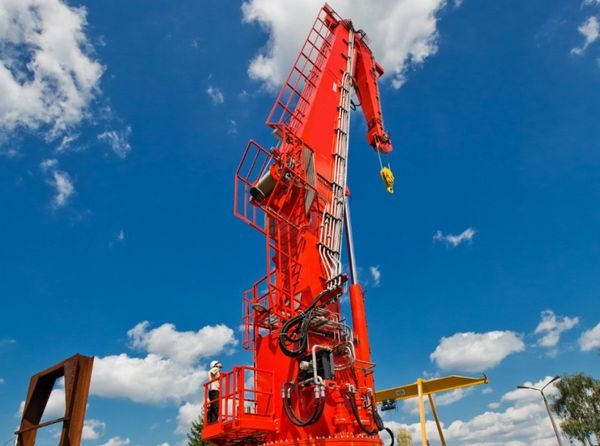
Expom, a company from Kurzętnik, has finalized an order for seven of the most modern cranes in the company’s history. One of them is a Knuckleboom-type crane with a structural weight of 50 tons, featuring advanced technological solutions. The entire project, commissioned by a client from Scandinavia, amounted to 350,000 EUR.
This is the largest crane, in terms of load capacity during testing, produced to date at Expom. The Knuckleboom-type crane features a characteristic two-part folding arm design. This type of crane is equipped with an additional hydraulic cylinder mounted between the main and outer arms, which enables the folding and unfolding process. Due to the specifics of its design, the Knuckle-type crane has greater maneuverability, which significantly improves cargo transport.
The machine has been equipped with the capability for remote operation via the Internet. Once an internet connection is established with the crane’s controller, it is possible to remotely control the unit for service purposes, even from the other side of the world. The crane will be used to service offshore wind farms, making this capability extremely valuable. The Knuckleboom device presented ambitious requirements, mainly due to the sizes and diameters of the materials used. The lifting range is up to 24 m, and the nominal lifting capacity is 24 tons at maximum outreach, which classifies the structure as the largest crane produced in the over 60-year history of Expom S.A.
The structure of the equipped crane itself reaches a weight of 50 tons, and approximately 80 gross tons of steel were used for its production. 300 liters of high-quality, three-layer chemical structure paint were used to coat the entire machine. The crane is equipped with a cabin to improve the operator’s working conditions, given the unit’s adaptation for continuous operation. In addition, it is equipped with a camera with a light at the end of the arm and a second camera monitoring the winch drum operation, which significantly facilitates the operator’s work and ensures greater safety while performing tasks. The crane has overload sensors with load scales, protecting the structure against overloads and potential damage.
During the dynamic test, the structure was tested for overloads and lifted a weight of approx. 30 tons at maximum outreach. Offshore cranes, unlike construction cranes, do not have a counterweight, which poses a challenge for the test stand. A weight of approx. 30 tons at a distance of 24 m from the crane’s mounting point generates forces capable of tearing out the previously designed steel structure of the test stand along with its concrete foundation. To conduct the test for this crane, it was therefore necessary to additionally reinforce the existing test stand at Expom by anchoring it. All cranes were supervised from the initial stages by an inspector from the DNV-GL classification society – a Norwegian maritime association that oversees machine production in accordance with global maritime standards.
Due to the company’s headquarters in Kurzętnik being located far from the sea, the transport itself was quite a challenge. The crane was dismantled and transported by road as an oversized load to the port of Gdańsk, from where it was delivered by ferry to Scandinavia. There, it will be used to service offshore wind farms.