









On June 30th, new, simplified rules for assigning numbers to trade items came into effect. The current standards for managing GTIN numbers are the result of several months of work by the global UniqueID working group, composed of representatives from 25 companies from around the world (including PepsiCo, Nestle, L’OREAL, P&G, Unilever, Ebay, Google, Alibaba.com, TESCO, Walmart, Carrefour, MetroGroup), which developed guidelines to significantly facilitate the assignment of numbers to products and their management in the supply chain.
Instead of the 46 rules that were in force until now, 10 basic guidelines have been created that require the assignment of a new GTIN. Ultimately, the global group aims to develop a solution that will enable effective identification of product variants and easy management of information about them on the Internet.

In pursuit of the dynamically changing retail trade, for over 40 years, the rules regarding the assignment of Global Trade Item Numbers (GTIN) have undergone greater or lesser modifications. As a result, a set of rules was created which, in the opinion of some key supply chain participants, are too complicated and too technical, which leads to their improper interpretation and is a significant challenge for many companies. Additionally, due to the desire to meet the needs of increasingly demanding customers who expect constant changes and the introduction of new product versions, it has become more difficult to effectively manage different product variants.
Omnichannel sales have also become a significant challenge. Customers shopping online, due to the lack of the ability to directly compare products as is the case during traditional shopping, expect reliable, accurate, and more detailed information about the items they are buying. The lack of accurate information about a given product limits informed purchasing decisions and often even results in the abandonment of purchases.
Taking into account the needs of all supply chain participants, the GS1 organization, by launching the UniqueID project, set itself the goal of ensuring a level of product identification that, on the one hand, will satisfy the expectations of omnichannel trade, and on the other hand, will meet the expectations of other supply chain participants for whom the increasing product variance is not significant and hinders data exchange.
Activities carried out as part of the project focus on 4 main areas:
1. Collecting and standardizing all similar GTIN assignment rules and creating generalized, clear rules based on them to support the management of Global Trade Item Numbers.
2. Developing a simple and concise set of guidelines that will significantly facilitate the decision-making process when assigning GTINs, and will also be more useful and meet the requirements of all supply chain participants and customers.
3. Assessing the impact (both positive and negative) of discontinuing the reuse of a GTIN after the required grace period and creating recommendations in this regard.
4. Preparatory work around the topic related to the identification of product variants, which are strongly correlated with the rules for assigning GTIN numbers.
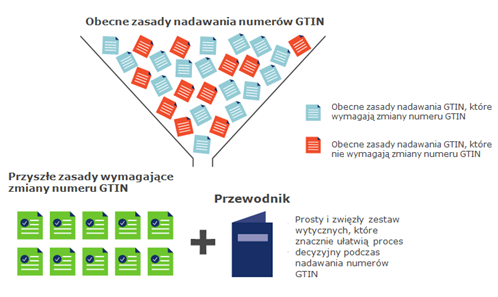
The first step of the preparations was to collect and standardize all similar rules and indicate a few most important rules that will absolutely require the assignment of a new GTIN (for new products) and the change of an existing number for products that are being modified. In the next stage, work will focus on developing an effective way to identify product variants.
The current rules for managing GTIN numbers, along with an online guide that will facilitate the decision-making process when managing numbers, can be found at: http://www.gs1.org/1/gtinrules/pl
Contact person:
Agata Horzela
tel. 61 850 49 71
e-mail: agata.horzela@gs1pl.org
Presentation: 10 basic rules – when should you change the GTIN number?