









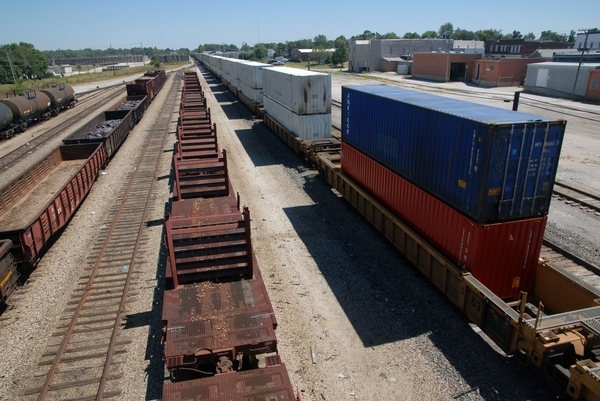
The modern economy poses increasingly greater challenges for transport operators. Combining different modes of transport is one of the solutions that allows transport companies to expand their operations.
Among the various combinations between these modes, combining road and rail transport in Poland remains a rarely used solution, yet one showing certain development trends. This situation is conditioned by the influence of many factors, both economic and technical, which largely constitute barriers in the form of regulations and access to appropriate infrastructure. The gradual elimination of these barriers is a key condition for the development of intermodal transport, with particular emphasis on rail transport. In this article, the author analyzes the functioning intermodal transport system based on a transport company. The specificity of intermodal transport requires an appropriate approach in the sphere of management for the entire transport system. Thanks to detailed information, it was possible to examine the dependencies characterizing different types of transport.
Organization of transport systems
Transport systems, as well as transport itself, can be considered in terms of factors shaping the national income. Their main tasks can then include: forming the spatial structures of the economy, realizing trade turnover in a given area, or influencing the development of economic entities. The concept of a system is very often identified with a certain type of structure, which is characterized by individual input and output elements. In general terms, causal relationships occur between given elements, so that by knowing the states at the system input, one can predict the output effects. By acting in a specific way on the environment, the system creates input parameters, while, understood as a unit of action, it must overcome all problems of variability and environmental dependencies.
The main task of transport systems in a holistic sense is to create appropriate conditions and possibilities for movement for its users. In relation to freight transport, this concerns the systematization of material flow streams. The functionality of a transport system largely depends on the quantity and type of transport means; equally important are appropriate infrastructure and the quality of transport operations performed.
The article contains 25,910 characters.
Source: Logistyka Magazine