









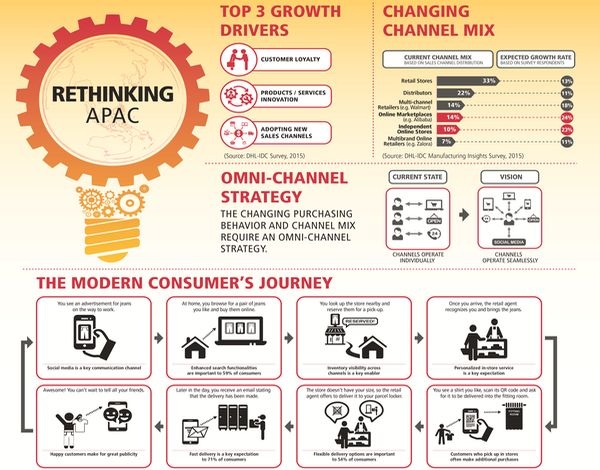
The DHL study on Asian trade trends (“Demystifying Asia Pacific Trends”) provides an analysis of trade trends in the APAC (Asia Pacific) region and their impact on local supply chains. In today’s global macroeconomic environment, the APAC region, holding the position of the world’s most dynamically developing region, remains a beacon of hope and a key growth sector. The importance of this region for global trade will continue to grow, and according to the latest forecasts, by 2030, trade routes there will account for 50 percent of the fifteen key routes.
Emerging manufacturing hubs, rising domestic consumption, and dynamic growth in e-commerce are key elements stimulating sustainable development. China remains the undisputed manufacturing hub, despite the diversification and orientation of companies’ activities toward neighboring emerging markets such as India or Vietnam. Companies are adopting the so-called “Plus One” strategy, which is a result of rising labor costs, the need to increase resilience, and the solid potential in these markets. Trade initiatives such as the Trans-Pacific Partnership (TPP) will make APAC countries, especially Vietnam, more attractive manufacturing bases.
Investing in six high-potential Asian economies (China, India, Thailand, Vietnam, Indonesia, and Malaysia) and, consequently, in six key trade routes, such as China-India or China-Indonesia, which will be among the top fifteen global trade routes by 2030, is of significant importance.
– To benefit from the growing regional trade in goods, companies should plan to invest in the 6 Asian economies and expand initiatives such as the TPP, ASEAN, Economic Community (AEC), as well as rail and road infrastructure to eliminate internal APAC trade barriers and increase multimodal transport solutions. Enterprises have the opportunity to adopt new strategies for providing better services at a lower cost – states Mei Yee Pang, Vice President of Innovation, Solution Delivery & Service Management APAC, DHL.
Cross-border e-commerce infrastructure will be a key element enabling significant growth in this region. The development of this sector has enabled small and medium-sized enterprises to access new markets, leading to an increase in cross-border trade turnover.
– Asia Pacific is the largest and most dynamically growing B2C sales region, which recorded sales of 877.61 billion in the e-commerce sector in 2015 and is projected to grow to 1.89 trillion by 2018. The development of the e-commerce sector has introduced changes in customer habits and expectations. Customer demand in the APAC region is focused on highly personalized shopping journeys with conveniences such as “online” and “offline” fulfillment and the option of moving freely between channels – states Malcolm Monteiro, CEO, Asia Pacific DHL eCommerce.
– Logistics services in the e-commerce sector are undergoing dynamic changes in the face of new challenges and opportunities. The complexity of legal regulations and the fragmentation of the logistics services market are forcing the industry to develop better, more comprehensive solutions for end-to-end, B2B, B2C, and the growing B2B2C sales – claims Alfred Goh, President of Fast Growing Enterprises, DHL.
The DHL study emphasizes that internal APAC trade and the six Asian economies will continue to gain importance. Cooperation between governments, companies, and logistics service providers will ensure better initiatives, while enabling the full utilization of their potential and increasing the efficiency of supply chains in the region.
The “Demystifying Asia Pacific Trade Trends” study is available at: http://www.dhl.com/apactrends.