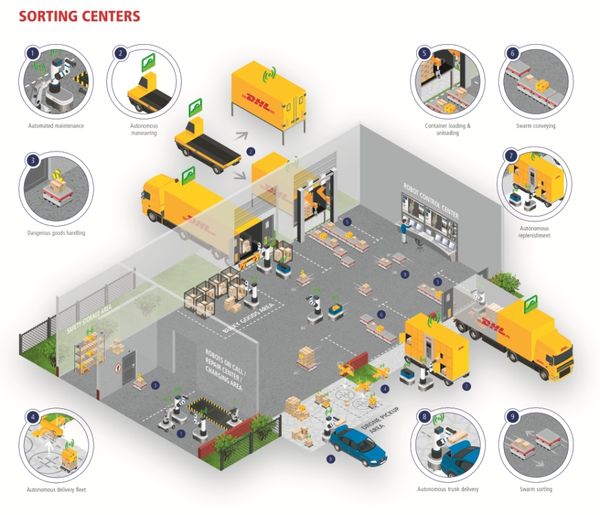
According to the Deutsche Post DHL (DPDHL) Group, a leading company in the logistics and postal services market, logistics is approaching a point where robots will become essential in the world of logistics services. The Group has published its latest trend report titled “Robotics in Logistics,” revealing the impact that the implementation of robots collaborating with humans will have on supply chains.
Robotics may soon dominate services such as picking, packing, and transporting goods in a logistics environment.
– Robots work in many industrial sectors, but this has not yet affected logistics due to the complexity of the work, i.e., performing a series of different tasks in an infinitely large number of combinations, near people, and in confined spaces. Current research indicates that 80 percent of logistics facilities are still operated by humans. Recently, however, technologies have begun to be adapted to the needs of using flexible and low-cost robots that can collaborate with humans in the logistics services sector – stated Matthias Heutger, Senior Vice President of Marketing and Innovation at DHL Customer Solutions & Innovation.
Robots will soon become standard in warehouses around the world
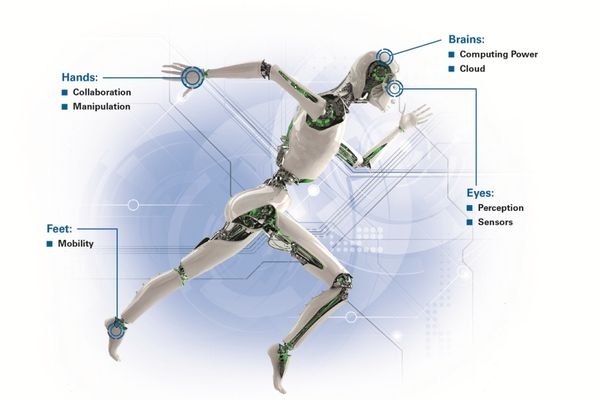
The aforementioned report highlights the accelerated development of next-generation robots capable of seeing, moving, reacting to their surrounding environment, and performing precise tasks in conjunction with humans. This process is stimulated by factors such as labor intensity, e-commerce, as well as shrinking and aging labor resources. As a result, projects funded by governments, investors, and key retailers in several countries are driving large-scale new research, which is influencing the creation of robots related to logistics services. In addition to the USA, China, Russia, and Japan, Europe also holds a solid position in this “robot race.” As part of the European Commission’s SPARC program, the EU will invest 700 million euros in industrial robotics research, while a consortium of 180 European companies is expected to contribute an additional 2.1 billion euros by 2020.
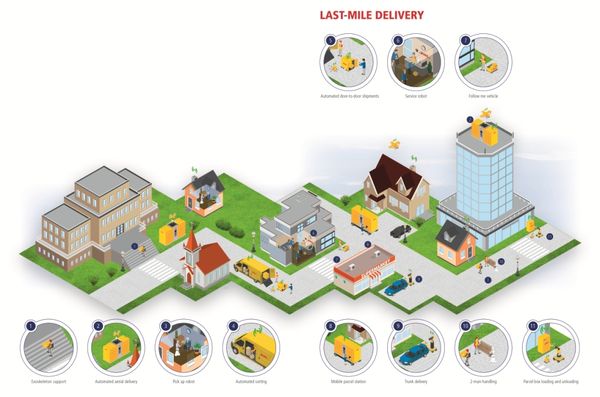
– Just as our children cannot imagine a world without computers, their children will likely not be able to imagine it without robots. Developing next-generation industrial robots capable of working with and around humans will require massive investment in such technologies, but we at the DPDHL Group believe that goods will soon be handled in supply chains faster and more cost-effectively by robots and humans working together – said Clemens Beckman, Executive Vice President of Innovation and PeP (Post – eCommerce – Parcel) Operations at the DPDHL Group.
Results of prototype trials will be published during the Robotics Day organized by Deutsche Post DHL
The DPDHL Group has already begun testing robots and their role in the logistics services sector. Trials using robots, aimed at finding solutions to transform supply chains, have been conducted in selected warehouses. The pace of technological progress is increasing thanks to the latest improvements and breakthroughs being created almost daily. The outlook for robotics is extremely exciting, and the entire world of logistics services will benefit from the development of these technologies. Opinions on the tests will be shared during Robotics Day – an event organized at the DHL Innovation Center in Germany, bringing together leading minds in the automation and industrial robotics industry. It will be a day dedicated to discussions on the level of advancement in human-robot collaboration, combined with modern exhibitions from leading companies in the industrial robotics sector.
The “Robotics in Logistics” report contains opinions and current information from leading scientists and practitioners on robotics and was developed as part of the Logistics Trend Radar – a tool used by DHL to identify and maintain trends and technologies relevant to the robotics sector.