









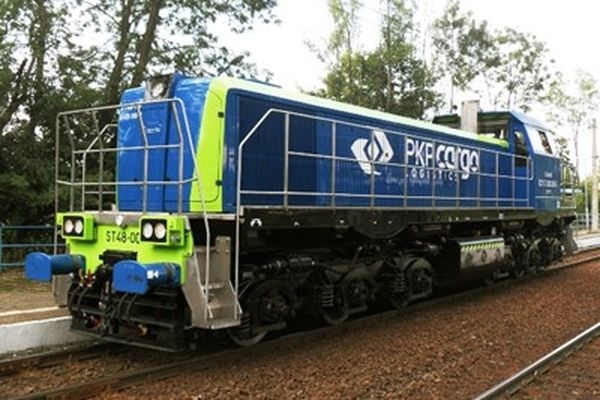
The Lithuanian equivalent of the Office of Rail Transport has officially authorized PKP CARGO to use ST48 series locomotives on Lithuania’s railway infrastructure. These vehicles can operate on standard-gauge lines. This will increase flexibility in locomotive management and reduce operating costs.
PKP CARGO obtained an indefinite permit for independent transport operations on the standard-gauge railway network of Lithuania in May 2014. Thanks to this, the Polish carrier can independently carry out transport to the terminal at the Šeštokai station, located 22 km from the border. This shortens transport time, as such a solution eliminates time-consuming transfer of shipments between carriers at the border.
– We are systematically increasing our capabilities for transport operations outside the country. The best option is to adapt the machines we currently possess. In this way, the third series of locomotives from the PKP CARGO fleet can now enter Lithuania. Thanks to this, we have greater possibilities in traction vehicle management and a good base for developing independent transport activities and increasing the attractiveness of our offer for customers – says Wojciech Derda, member of the PKP CARGO management board for operations.
The most frequently imported goods by rail from Lithuania are wood, while metals and chemicals are mainly exported from Poland. So far, PKP CARGO has used ST44 and SM42 series diesel locomotives in Lithuania.
The ST48 is a six-axle modernized SM48 locomotive. PKP CARGO has subjected several dozen of these vehicles to a thorough rebuild. The modernized locomotives use a modern diesel engine with nearly double the power (an increase from 882 kW to 1550 kW). The modernized machines also consume less fuel, which lowers operating costs. They can now be engaged in both shunting work and hauling trains.
In addition to Lithuania, PKP CARGO can independently conduct transport in eight other European Union countries: Poland, Germany, the Czech Republic, Slovakia, Austria, the Netherlands, Belgium, and Hungary. To service connections abroad, PKP CARGO uses multi-system electric locomotives (they serve three main corridors: Poland-Czech Republic-Austria, Poland-Germany-Netherlands, and Germany-Poland-Czech Republic-Slovakia-Hungary), single-system electric locomotives (in the Czech Republic and Slovakia), and diesel locomotives (in Germany, the Czech Republic, Slovakia, and Lithuania).
On September 23, 2015, PKP CARGO signed an agreement for the purchase of 15 multi-system locomotives from Siemens for nearly 315 million PLN. The first three new vehicles will appear at PKP CARGO as early as the beginning of 2016. They will serve connections to the west and south of Europe. To launch trains, a railway carrier must obtain a so-called safety certificate. It is divided into two parts. Part A confirms the acceptance of the safety management system held by the carrier, in accordance with national and EU regulations. Part B is a direct permit for operations in a specific EU country. It is issued by the local market regulator. Holding Part A is a condition for applying for Part B. PKP CARGO holds the former until 2019. It was issued by the Office of Rail Transport.