










Intermodal transport can be described from various points of view. Most often, intermodal transport is presented as a transport chain integrating road transport with rail or water transport.
In such a definition, the road carrier performs a feeder function between the cargo sender and the terminal, and a delivery function between the terminal and the cargo recipient, while the rail operator is understood as the main participant in the transport chain. The advantage of the former is its near-unlimited access to loading points. It is characterized by flexibility in the selection of body types, depending on the type of cargo being transported. On the other hand, rail and water transport are characterized by the ability to transport large quantities of cargo at relatively low costs. The development of intermodal rail-road transport technologies in Europe over the last few decades has led to the creation of a number of technical systems optimized for minimizing transport costs, and especially the costs associated with the transshipment of intermodal loading units from trucks to rail platform wagons at intermodal terminals – the contact points between road and rail transport. Depending on the type of intermodal loading unit involved in the intermodal transport chain, we can speak of two transshipment systems: the vertical transshipment system and the horizontal transshipment system. Vertical transshipment (also known in the literature as the non-accompanied system) is the transshipment of containers, swap bodies, and semi-trailers. In this system, 94.7% of TEUs were transported in Europe in 2011. The dominant intermodal loading units are containers transported in domestic and international relations.
Transport of containers and swap bodies
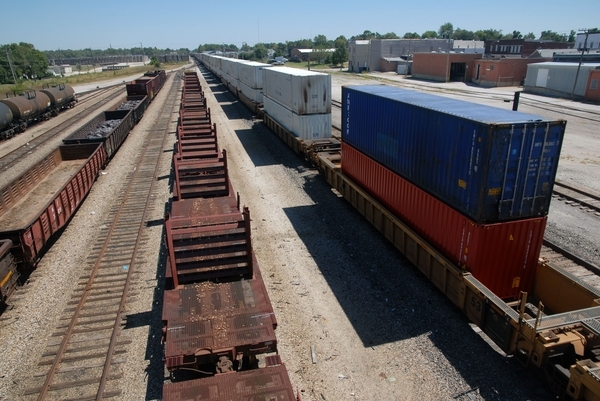
For the transport of intermodal loading units using vertical transshipment technology, several types of special “S” type platform wagons are currently used, including four-axle, articulated six-axle, and multi-unit eight-axle wagons with a lowered floor height. Most of them are adapted for speeds of 120 km/h. However, rolling stock manufacturers are increasingly offering platform wagons adapted for speeds of 140 km/h. The standard bogies in these wagons are Y25 type bogies, manufactured in various versions and adapted for a maximum load of 22.5 t/axle.
The article contains 14,980 characters.
Source: Logistyka Magazine