









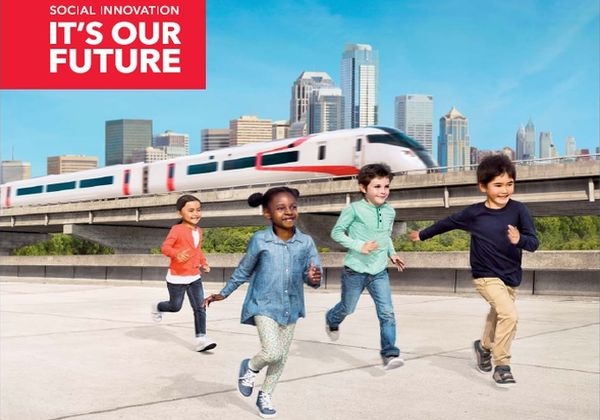
A new study conducted by Frost & Sullivan in collaboration with Hitachi Europe Ltd., a subsidiary of Hitachi Ltd., reveals that companies implementing social innovation in the transport and mobility sector can count on total savings of USD 550 billion. The three biggest challenges associated with urbanization – traffic congestion, air pollution, and road accidents – can be effectively countered through social innovation. It provides returns for investors, savings for public authorities, and better health and well-being for citizens.
Social innovation is defined as innovation that introduces positive changes in the lives of societies and individuals, requiring the collaboration of technologies, industries, products, and business models. This definition can be applied to the transport sector, where new technologies can provide benefits to both local communities and wider society.
– Companies and public administration bodies that introduce social innovations to counteract the negative effects of urbanization – particularly air pollution and traffic congestion – will not only achieve significant profits but will also provide society with ten times greater benefits. This requires analysis, mainly of Business to Society services providing collective benefits, as well as at the consumer and business level in terms of increasing travel comfort – said Martyn Briggs from Frost & Sullivan.
The research report highlights the decisive role of smoothly operating and integrated mobile connectivity networks in the effective transport infrastructure of the future. It also points out how the most important challenges can be addressed:
• Reducing traffic congestion by 20% through traffic flow optimization using intelligent traffic management systems and vehicle-to-vehicle communication. This could bring savings in Poland alone at the level of USD 2.1 billion.
• Increasing transport efficiency (in terms of energy consumption and optimal utilization) will reduce emissions by 10%. For example, further automation and intelligent routing can reduce fuel consumption by 10%, which in the Polish market means savings of USD 2.7 billion.
• Automatic and intelligent mobile connectivity can reduce the number of accidents by 25% by 2030 through a combination of accident response and collision avoidance solutions.
In this way, social innovation in the field of transport can bring significant economic, social, and environmental benefits – including reducing pollution emissions by 10%, traffic congestion by 20%, and fuel consumption in transport by 10% globally. Reducing the number of road accidents by 25% through social innovation could bring savings in Poland at the level of USD 0.9 billion.
– Business can significantly contribute to overcoming the challenges facing society. Companies that manage to take a fresh look at innovation have a huge opportunity ahead of them – said Dieter Rennert, CEO of Hitachi Ltd in the EMEA and CIS region. – This is particularly visible in the transport sector, where the foundations for socially innovative business are being built. By influencing the future of transport infrastructure, increasing safety and travel comfort, and protecting the environment in cities, companies can introduce innovations that benefit the entire society.
Social innovation and the associated savings are being realized not only by urbanization but also by three other related trends: connectivity, changing social preferences, and intelligent management.
• Connectivity: it is projected that by 2025 there will be 80 billion devices connected to the Internet. Such penetration of devices and infrastructure creates huge opportunities for using big data and developing mobility. This is already benefiting user comfort (e.g., through apps for hailing taxis or checking train status in real-time). The next wave of development will go even further, enabling greater network automation and connecting vehicles with infrastructure and devices.
• Changes and social preferences: the public’s perception of transport is constantly changing. Acceptance and preference for public transport are growing. The proportion of public transport in several megacities already exceeds private transport, which is influenced by significant development of transport infrastructure and a change in attitude. For example, in London, only 34% of trips are made by private cars – other options include public transport, walking, and cycling.
• Intelligent management: public policy will play an increasingly important role in the effective and organized delivery of innovative, integrated mobility solutions. This can take various forms: from sharing vast urban data resources with private developers, to prioritizing public transport and bicycles on roads, or investing in infrastructure. The report also emphasizes the importance of cooperation between government bodies to develop an integrated approach to providing transport. Examples include high-speed rail networks that will eventually connect entire continents, not just countries.
– Companies and public authorities must work together to realize social innovation that will ensure the dominance of public transport over private transport – said Martyn Briggs from Frost & Sullivan. – Ultimately, this will lead to the creation of a more complex but efficient transport ecosystem, in which passengers are better informed about available options and operators better understand their passengers.