










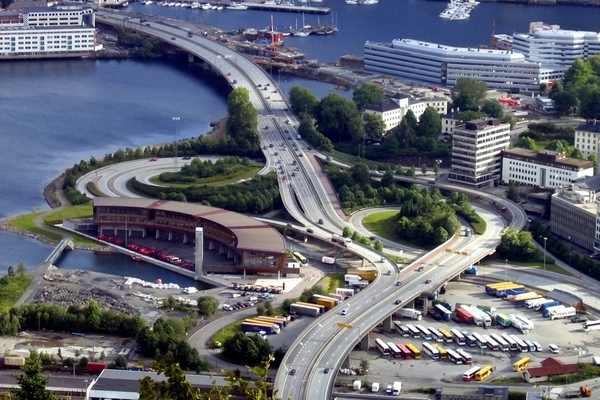
Progress in communication brings consequences in the form of an increasing number of motor vehicles, the formation of traffic jams in the road network, and disturbances that reduce traffic flow. The result of these phenomena is transport congestion in urban road systems, which means traffic density on transport routes and bottlenecks.
Increasing road traffic causes a decline in the attractiveness of cities, and above all their centers, which prompts a change in the organization of motorized vehicle traffic. To reduce the phenomenon of congestion, solutions have been sought that provide a balance between the use and improvement of traffic in the existing communication network and the construction of new, capital-intensive transport solutions. One of the solutions improving the flow of people and goods without the need to build new roads is Intelligent Transport Systems.
The concept of flexible traffic lanes
The solution to the problem of congestion in Polish cities is not just widening existing roads with additional lanes. Such actions often have the opposite effect to that intended. Developing tasks aimed at reducing the phenomenon of congestion requires an individual approach. There are no two identical cities; each differs in its character (tourist city, industrial city), population, or – in terms of logistics – available modes of transport. These factors have a direct impact on the direction and pace of the city’s development. Any actions that aim to optimize transport in the city should begin with detailed research and analysis regarding traffic volume measurement, driver and passenger behavior, weather conditions, the availability of specialized companies, and many other factors affecting the quality of transport in the city. Such studies should be multi-stage and cover the longest possible period of time. Only after developing and analyzing the results can optimization measures be proposed. One of the possible solutions in this area is telematics systems. Their operation can be observed, for example, on motorways in the form of warning messages on variable message signs. Another example of telematics solutions are boards at tram stops informing passengers in real-time about the public transport timetable. The most common and playing a huge role in traffic control are induction loops, usually located at road intersections. Their task is to detect approaching vehicles from different sides of the intersection. This information is transmitted to the controller and then to the traffic lights in the form of a light allowing passage. The essence of traffic lights coupled with induction loops is to react in real-time to changing traffic intensity and adjust optimal time intervals for passing vehicles. Combining many such intersections on a straight section creates a small traffic management system that allows for improving vehicle flow. Solutions of this type do not require the expansion of existing intersections, yet they clearly contribute to improving traffic and thus reducing travel time. Unnoticed by many road users is the use of the capacity of a traffic lane per unit of time (for example, 1 day). In the case of roads that consist of three lanes (two lanes in one direction and one in the opposite direction), there is often an uneven load. Such a phenomenon can be noticeable if the aforementioned road is an access road to the city.
The article contains 29,810 characters.
Source: Logistyka Magazine