









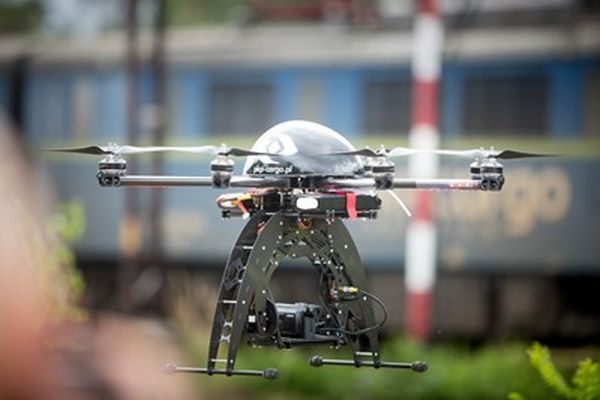
Following several months of testing, PKP CARGO is now regularly using purchased drones to secure its trains across the country, with a particular focus on the Silesian Voivodeship. The unmanned aerial vehicles are operated by specially trained operators who have passed state examinations and obtained certificates from the Civil Aviation Authority. The use of modern equipment is part of the fight against cargo theft. Thanks to initiatives undertaken by PKP CARGO, losses due to theft of goods from trains were reduced by nearly 60 percent in the first half of the year.
In securing its trains, PKP CARGO focuses primarily on prevention. The carrier cooperates with the Railway Security Guard and the Police, who are responsible for prosecuting perpetrators of crimes. In 2014, a special Operational Team was established within PKP CARGO, whose primary goal is to reduce the losses incurred by the largest Polish carrier.
– In cooperation with the Railway Security Guard and the Police, we have intensified preventive measures. Recorded losses have decreased by PLN 1.6 million. The use of drones certainly had a significant impact on such a good result, and it is worth remembering that this was only the testing period for the devices. We have started regular use of the machines to protect our transports – says Maciej Borecki, Director of the Security and Audit Office at PKP CARGO. – Drones will also find many other applications – we will use them, among other things, to check whether wagons handed over by customers have been properly emptied. This will significantly shorten the time of such inspections, which are necessary for smooth operations.
Drones record images near the trains and transmit them in real-time to the headquarters of the Operational Team. Because the cameras mounted on them have high-quality optical zoom, it is possible to obtain evidence that allows the Police to identify the perpetrators of the theft. In the air, the machines are practically inaudible, and due to their small size and color, they are also difficult to spot. This significantly increases their effectiveness. Drones can also be used at night and during poor weather conditions, as they are equipped with high-quality thermal imaging cameras, allowing for the detection of a human from a distance of over a kilometer. PKP CARGO will use drones throughout Poland, but primarily in Silesia, where the scale of incidents is the greatest.
– Silesia is of key importance to us because this is where 60 percent of domestic and 70 percent of export shipments originate. It is also in this region that we record nearly three-quarters of cargo thefts – explains Maciej Borecki.
PKP CARGO drone operators have undergone careful training, including: aviation law, operational procedures, flight rules, as well as practical training in piloting unmanned aerial vehicles. They also passed state examinations and received certificates and qualification licenses issued by the Civil Aviation Authority. These qualifications are necessary to perform drone flights in Poland.
According to PKP CARGO data, in the first half of 2015, the value of stolen shipments and goods in railway areas fell by 59 percent year-on-year. The number of incidents during this time decreased by 44 percent. Criminals most often steal coal from PKP CARGO trains. In the first half of the year, 350 such thefts were recorded, which is 36 percent less than a year ago. The number of thefts of scrap metal, another commodity “popular” among thieves, fell by as much as 62 percent. The perpetrators of the thefts are usually very well-organized criminal groups. One of the most frequently used methods is attempting to stop the train, for example, by placing obstacles on the tracks. To avoid a disaster, train drivers must stop the train and inform the appropriate services about the incident. Thieves then carry out a so-called “dumping” within a few minutes. During a single incident, thieves are able to steal even several tons of coal.