










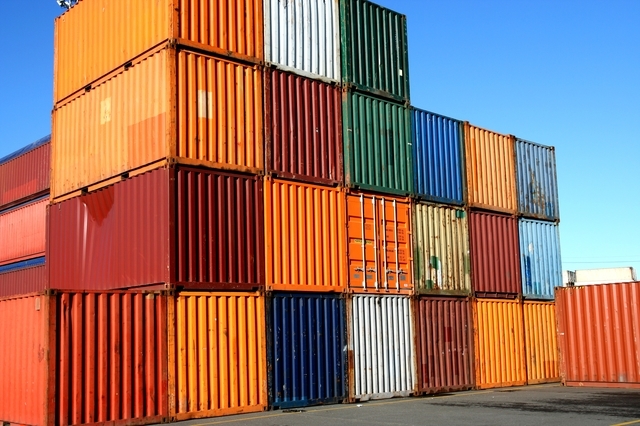
When on April 26, 1956, Malcolm McLean shipped the first 58 35-foot containers from Newark to Houston aboard a converted tanker, the “Sea-Land,” he certainly did not suspect that his invention would revolutionize not only transport over the next few decades, but would also become one of the primary vehicles for internationalization and globalization, bringing about significant transformations in industry and trade worldwide, and contributing to accelerating the development of regions where container handling and transport are currently the most efficient and effective.
Handling operations in seaports, which were still performed by dockers mainly using their own muscle power in the 1950s and 1960s, were neither fast nor particularly safe, but certainly expensive. The cost of transshipping 1 ton of typical general cargo was nearly 6 USD at that time. The introduction of containers reduced this cost to just 16 cents. Today, a basic operation, i.e., moving a container from a ship’s hold to a terminal, costs from several dozen to about 200 USD. For example, at DCT in Gdańsk, this cost is 92 euros for a full 20-foot container and 106 euros for a 40-foot one. However, it must be remembered that modern containers can be packed with cargo weighing up to 30 tons, so in terms of 1 ton, even nominally, it is the same or less than 50 years ago. And if one takes into account the cumulative inflation over this period, it turns out that this cost is much lower than it was then. Transshipment time has also been shortened. Already by the end of the 1960s, container ships sailing from Japan to ports on the US West Coast and back spent only 3 days in ports, while their traditional competitors (typical general cargo ships) spent as many as 20. As a result, the number of voyages per year per ship increased from 9 to 15. The use of huge quay cranes and other transport and handling equipment, allowing for efficient and fast movement of containers within terminals – despite the significant increase in container ship capacity – has meant that transshipment time rarely exceeds 24 hours, and moving a container from a terminal tractor to a ship or vice versa takes 2-3 minutes. Thanks to shorter stays in ports, it was possible to transport more using the same number of ships, and thus the fixed costs of purchasing and maintaining the fleet decreased. They also decreased because increasingly modern container ships required fewer crew members. In the early 1970s, container ships launched in Germany had a capacity of 3,000 TEU (Twenty-Foot Equivalent Unit) and were operated by 38 crew members. Today, the largest container ships are able to carry as many as 18,270 TEU with a crew of only 13 members, although it standardly consists of 19 officers and sailors. Such a huge increase in capacity means achieving significant economies of scale. Despite the increase in the size of container ships, designers have ensured that subsequent generations consume less and less fuel (per unit of capacity) and thus generate lower and lower operating costs, and at the same time lower external costs.
The article contains 21,580 characters.
Source: Logistyka Magazine