








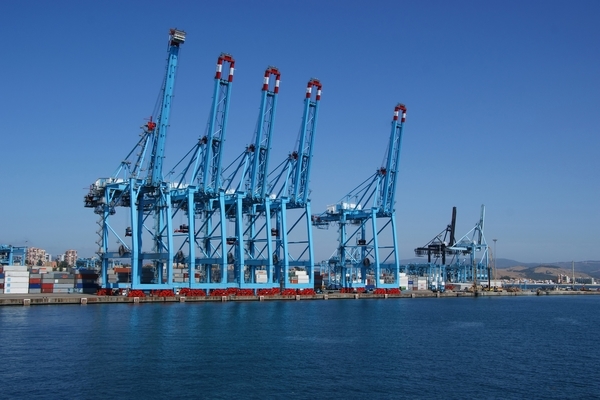
The increase in the number of containers and the volume of goods is the result of active marketing by privatized container terminals. As a result, there has been an increase in the supply of both general cargo and bulk cargo: in Gdańsk, the 30 million tonne mark was exceeded, the terminals of the Szczecin-Świnoujście complex approached 23 million tonnes, and in Gdynia, they significantly exceeded 17.7 million tonnes. The estimated value of cargo moved through Polish ports has approached PLN 500 billion.
Privatization and investments
A breakthrough in the development of the container handling market offer was the acquisition of the Baltic Container Terminal (BCT) by the international corporation ICTSI (based in the Philippines). In 2006, Gdynia Container Terminal SA (GCT) was launched. The investor is Hutchison Port Holdings (HPH), which built a container terminal on a total area of 18.6 hectares with a 625-meter-long coastline. Investments in container terminals resulted in an increase in container handling potential and growth in transshipments before the 2009 recession, followed by a market recovery after 2010. In the vicinity of the terminal, construction of the Bulgarian Quay began in 2013, which will be adapted to handle container ships.
In Gdańsk, the DCT terminal is being expanded, and the new berth being created should increase handling potential by 1 million TEU. The “Port Północny” Sp. z o.o. (Northern Port) transshipment and storage enterprise, owned by the Belgian SEA-INVEST Group, is also investing; it manages an area of 59.2 hectares with two piers (coal and ore) for handling bulk goods. In the near future, the ore pier will be renovated, storage yards (approx. 100,000 sq. m.) will be built, new technological equipment will be purchased, and the road system will be expanded. In Świnoujście, a new berth for ferry handling is being built at the ferry terminal, and the company OT Logistics is expanding the potential of the Port of Świnoujście with a new container terminal. It is assumed that after the completion of the investment, it will be possible to handle 200,000 TEU annually.
Privatization and marketing
Terminals in private hands conduct active marketing, which has contributed to changes in structure and an increase in transshipments. In Gdańsk and the Szczecin-Świnoujście port complex, general cargo handling began to play a greater role, and in Gdynia, the supply of coal increased. A spectacular example is the construction of DCT from scratch, where in 2013 the 1 million TEU threshold in container handling was exceeded, clearly marking the general cargo character of the port in Gdańsk. Through DCT’s strong ties with Maersk Line, the world’s largest container liner operator, Gdańsk was included in this operator’s Far East service. The introduction of the largest Triple-E container ships with a capacity of 18,000 TEU brought a new quality to the service, and in the near future, Gdańsk will be the destination port on the Baltic for the P3 alliance.
Since the Gdynia Bulk Terminal was incorporated into the ATIC Group, coal transshipments in the port of Gdynia have been constantly growing. The ATIC Group (based in Paris) is a leading bulk cargo operator. Thanks to marketing in global markets, the supply of coal cargo has increased in Gdynia.
The article contains 11,330 characters.
Source: Logistyka Magazine