









25% of companies using the warehousing services of an external logistics operator formally report shortages. In most cases, the level of losses is decreasing, but in many companies, the situation is still not satisfactory. Companies: ROHLIG SUUS Logistics – a truly comprehensive logistics operator – and Data Group Consulting – a market research agency – conducted a study showing the scale of the phenomenon and the attitude of companies towards inventory shortages.
The level of losses is decreasing
Trading companies reported the occurrence of shortage problems twice as often as manufacturing companies (18% compared to 36%). The e-commerce industry was in the middle of the pack with a result of 31%.
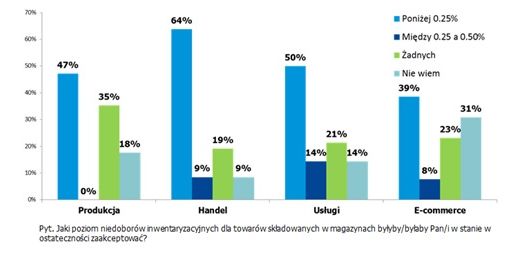
The level of inventory losses for 85% of the surveyed companies is less than 0.25% of the cost of purchasing goods. Higher figures are mainly indicated by companies from the e-commerce sector (25% of respondents estimate losses at the level of 0.25-0.5%).
More than half of the respondents also claim that the level of inventory shortages has decreased in recent years, and almost ¼ say it has remained unchanged. Only 7% of enterprises have experienced an increase in the level of shortages in recent years.
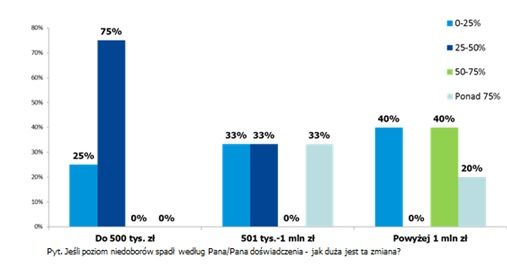
As the study shows, the largest decrease is achieved by companies that are characterized by a sufficiently high scale of logistics expenditures.
– Currently available, advanced IT solutions, in particular modern WMS systems, significantly influence the minimization of losses for clients. The ability to scan, locate, or inventory packages has meant that we have transparent data on the movement of goods in the warehouse. The level of security is also influenced by: the organization of the process and its level of tightness, as well as the controlling systems used, such as security or monitoring – said Anna Galas, Contract Logistics Development Manager at ROHLIG SUUS Logistics.
Clients are reluctant to tolerate losses
The level of acceptability of inventory shortages varies depending on the sector of the companies’ operations. More than half of the respondents accept inventory losses up to 0.25% of the cost of purchasing goods, but ¼ do not tolerate any shortages.
Trading companies accept the current level of losses, while manufacturing companies have the lowest tolerance for them and advocate for further reducing their level. This is interesting given the fact that they have the best indicators – among the surveyed manufacturing companies, none reported shortages higher than 0.25% of the annual value of goods. In the e-commerce sector, the level of inventory losses is the highest, but at the same time, a fairly low level of tolerance for them is visible.
– The results of the study confirm that the level of inventory shortages has been falling in recent years and the fact that logistics company clients accept the current level of inventory shortages. Objectively speaking, this problem most concerns trading companies, as they report the occurrence of shortages twice as often as industrial ones. This is also related to the actual level of losses: one does not encounter manufacturing enterprises that would report shortages higher than 0.25%, while in the trade sector (especially in the case of online stores) larger ones happen. However, the decisive factor is how much money is being turned over. It turns out that the higher the expenditure on external logistics, the more attention is paid to the issue of shortages (and it is even noticed that shortages occur at all!, i.e., they are the subject of a contract with a logistics operator). Those who incur high logistics service costs also approach the issue of an acceptable level of shortages more realistically than others; they do not expect a sharp drop or complete elimination of inventory losses. Against the background of large clients, the less stable situation of small companies from the e-commerce segment is highlighted – said Piotr Szreter, owner of Data Group Consulting.
Information about the study
The study was conducted on a sample of 988 companies from the sectors: production (33%), trade (43%), e-commerce (24%), which are focused on domestic trade in goods and use external warehousing services provided by logistics operators. The respondents were logistics department managers (participants in the cyclical Logistics Operator of the Year research program). Research method – telephone survey interview. Date of the study: June 2014. The study was conducted under the patronage of the Polish Chamber of Forwarding and Logistics (PISiL).