









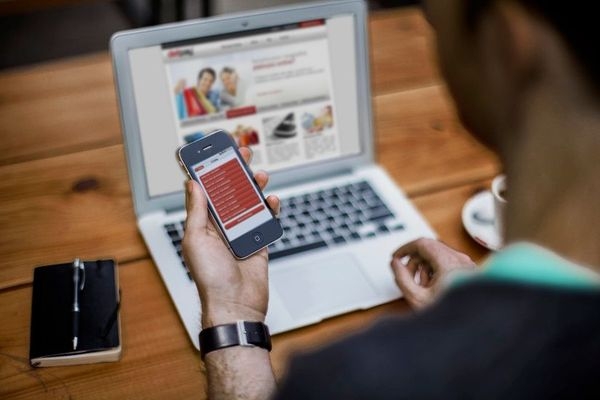
35% of internet users declare that they use a phone for online shopping, and 19% use a tablet, according to the “E-commerce in Poland 2014” report published by Gemius. This actually represents between 3.2 and 4.9 million paying e-customers, who could spend even several million zlotys annually. It is all the more surprising that few Polish online stores take care of this category of customers. And yet, the pre-holiday period and the time of post-holiday sales are moments when consumers spend the most.
Smartphones and tablets are increasingly popular e-shopping tools used by Polish internet users, especially those who rate their financial situation well. And indeed, according to the Gemius “E-commerce in Poland 2014” report, one in twenty respondents spends more this way than when shopping via a computer. These results may be influenced by the fact that half of mobile purchases are generated by owners of Apple devices, who are perceived as wealthier and more open to innovative solutions.
Forms are problematic for 66% of e-customers
Let’s see what e-commerce participants shopping via mobile devices complain about. For 66% of those surveyed by Gemius, the main problem is the cumbersome procedures involved in filling out forms when placing an order. Inconvenient payment methods (e.g., standard bank transfers), payment issues (27% and 26% respectively), as well as the complexity of the entire process, which 45% of buyers pointed out, are also major obstacles.
The market is already responding to these needs; for example, selected online payment operators are introducing convenient payment forms that work on all devices, and the first banks are simplifying the processes of using mobile banking. However, these are still exceptions.
Mobile payments can (and must) be improved!
Providing a convenient form of payment is a better chance of acquiring a paying e-customer. To ensure this, it is worth starting by replacing bank transfers, which are troublesome for mobile device users, with internet payment systems or online payments. There are several such solutions, e.g., mPay, SkyCash, Płacę z IKO, PeoPay, Masterpass, V.me. Each of them allows you to make a payment using a special application. Moreover, these systems also allow you to pay in regular stores, not just online, and even “transfer” money from one phone to another. The API interface provided by the payment operator will also help simplify e-payment processes.
– Such a system allows for the maximum shortening of the payment process, directing the customer from the store or application directly to the bank’s website. Smoothly and bypassing the cumbersome forms that customers find most frustrating – says Bernadetta Madej, Sales Director at Dotpay.
Why do banks and stores forget about mobile customers?
Certainly, providing all the tools mentioned above within a single contract with an online payment operator is a better chance of acquiring and retaining a loyal e-customer. Despite this, there are few well-thought-out and encouraging mobile sites for online shopping. Banks also pay almost no attention to customers making online payments. This is evidenced by the process of making a transfer by phone, which is difficult and time-consuming (requiring, among other things, copying and pasting data from the store’s website to the bank’s website). Moreover, some banks’ websites are practically unusable on a phone. On one hand, there are interface errors (lack of responsiveness, buttons that are too small, inability to zoom in on the page), and on the other, an ill-conceived payment process (the need to enter a masked password, automatic logout after switching from the browser to the SMS inbox to read the message with the password).
Online store owners also forget to simplify the payment process. Even if they decide to introduce online payments, they complicate the transaction flow by adding extra screens – selecting a bank or entering the same data multiple times. In addition, each screen looks different because it comes from a different entity – the store, the online payment operator, or the bank. Even if everything works technically, the internet user ends up in too many places that discourage them from finally making the payment.
As Bernadetta Madej advises, this process can definitely be simplified by remembering the bank and payment method chosen by the customer or by properly selecting the order of operations.
– Only 15% of stores use A/B testing tools, which allow them to check what prevents customers from making a payment. That’s not much, but after all, mobile payments are a new market that everyone should learn about through research and testing, not intuition – the expert concludes.
10 million Polish e-customers
In recent years, traffic from mobile devices has been growing at a rate of 150% per year. This means that next year, even more Poles may do their holiday shopping via smartphone or tablet. Does such growth seem unbelievable? Not at all! We are by no means a global exception – in the UK, Denmark, and other European countries, 1/3 of online purchases are made via a mobile device, and in the USA, it is over 50%. It is certainly worth taking an interest in mobile payments in online stores, because next year the number of Poles who will shop via mobile devices may exceed 10 million people. Such a group cannot be ignored!
Source: www.dotpay.pl