








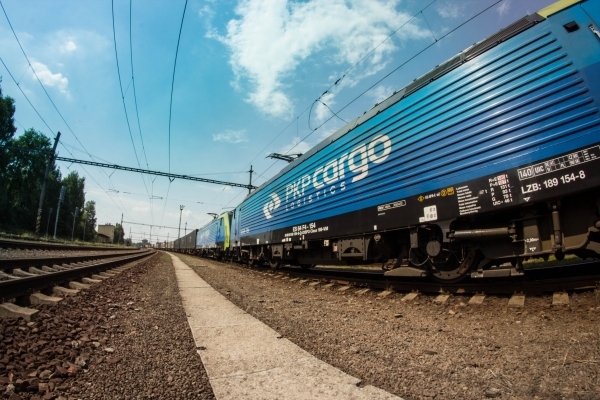
PKP CARGO has obtained a safety certificate from the Lithuanian regulator, authorizing it to independently carry out transport operations on standard-gauge sections of the Lithuanian railway network. Lithuania is the eighth European Union country whose regulator has issued a certificate to the largest Polish and second-largest European rail freight carrier. The company has also obtained extensions of its safety certificates for another five years in Germany, Austria, the Netherlands, and Slovakia. International operations are an increasingly important part of PKP CARGO’s business: in the first quarter of 2014, transit, import, and export accounted for a total of 53 percent of all the company’s transport operations.
– Obtaining the safety certificate in Lithuania is another step in implementing PKP CARGO’s strategy of international expansion. We are systematically building our position in the region by being able to conduct independent operations in eight European Union countries. Our goal is to become a leader in Central Europe and to offer our clients complementary logistics services by leveraging our transport and forwarding potential – says Adam Purwin, CEO of PKP CARGO.
The safety certificate in Lithuania expands PKP CARGO’s business competencies. Currently, the Polish carrier’s locomotives only reach the Mockawa border station, providing traction services on a several-kilometer-long border section for Lithuanian Railways, which acts as the formal contractual carrier on the Lithuanian side. The safety certificate issued by the Lithuanian regulator will allow PKP CARGO to operate as an independent contractual carrier to the Šeštokai station, where a freight transshipment terminal is located 22 km from the border. Lithuania’s railway infrastructure is based primarily on the 1520 mm standard (the so-called broad-gauge, Russian railway). Elements of the 1435 mm standard railway infrastructure (the so-called standard-gauge, European railway) account for a small percentage of the total railway infrastructure in the country, occurring only on the line: state border – Mockawa – Šeštokai. An opportunity to increase freight transport between Poland and Lithuania based on European-standard railway infrastructure may be the implementation of the Rail Baltica project – a standard-gauge railway line that is part of the trans-European transport corridor connecting Berlin, Warsaw, Vilnius, Riga, Tallinn, and Helsinki.
– Direct travel by PKP CARGO to the Šeštokai station will contribute to shorter transport times by eliminating additional steps in the process of handing over and receiving shipments between carriers at the border. Delivery time is one of the most important elements in the logistics process of shipping goods, which PKP CARGO clients place particular emphasis on. Furthermore, the ability to independently carry out transport to and from the transshipment terminal located at the Šeštokai station will give PKP CARGO a chance to expand its business – we will be able to offer clients the handling of the entire transport and commercial process through a single entity – says Jacek Neska, Board Member for Commerce at PKP CARGO.
In addition to obtaining the safety certificate from the Lithuanian regulator, in the first half of 2014, regulators from four other European Union countries: Austria, the Netherlands, Germany, and Slovakia, extended Part B of the certificate for PKP CARGO. The certificate for Hungary will also be extended soon. The largest Polish and second-largest European Union rail freight carrier also holds safety certificates for the Czech Republic and Belgium.
International operations are an increasingly important part of PKP CARGO’s business. In the first quarter of 2014, transit, import, and export transport accounted for a total of 53 percent of all transport operations carried out by the company. Diversifying revenue sources into foreign markets is one of the elements of the carrier’s strategy. In terms of revenue share from foreign external clients, companies from Germany (31 percent), the Czech Republic (18 percent), and Slovakia (12 percent) lead the way.
– At PKP CARGO, we place great importance on safety while conducting operations. Participating as a carrier in rail traffic both domestically and abroad, we realize that the safety of our operations is the most important matter. Regulators in European Union countries have no doubts about this, granting us safety certificates, including indefinite ones – as was the case recently in Lithuania. It is worth emphasizing that PKP CARGO is constantly raising its safety level, mainly by eliminating and minimizing identified and potential risks – says Wojciech Derda, Board Member for Operations at PKP CARGO.
A safety certificate is divided into two parts: A and B. Part A confirms that the railway carrier has a safety management system that meets all requirements provided for in national regulations and European Union legislation. Part B is a direct permit to operate in a given EU country, issued by the local regulator. Holding Part A is a condition for applying for Part B of the certificate. PKP CARGO holds Part A of the safety certificate until 2019. It was issued by the Office of Rail Transport.
Safety certificates are issued by national railway regulators for a maximum period of five years. PKP CARGO first received Part A of the certificate in 2009, and Part B for conducting operations in Poland in 2010.