








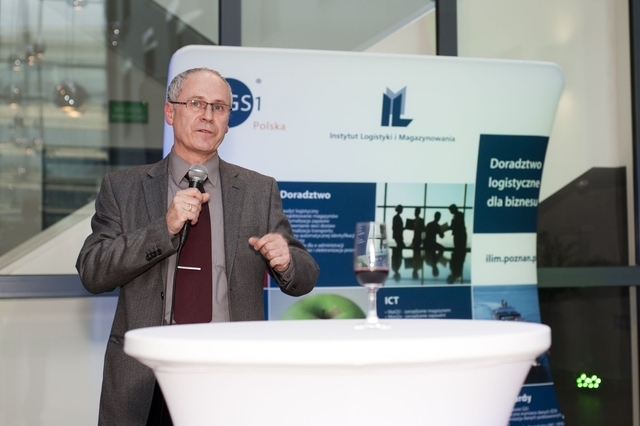
On the second day of the Polish Logistics Congress LOGISTICS 2014, participants took part in six thematic sessions, plenary meetings, and technical visits to partner companies. There was no shortage of additional attractions, including a demonstration of a tracker dog’s skills organized by the Customs Chamber, the final conference of the EMPIRIC project, and a speech by Witold Skowroński, a simultaneous interpreter who has worked for presidents Lech Wałęsa and Aleksander Kwaśniewski. During his Thursday presentation, Mr. Skowroński spoke about the art of communication in multicultural relationships.
Starting at 9:00 AM at the Poznań International Fair Congress Center, three sessions were held simultaneously, focusing on innovative warehouse infrastructure solutions, IT solutions, and the delivery of fast and reliable information in the supply chain.
– We are seeing a growing demand for electric-powered forklifts – said Tobiasz Jakubczak from Still Polska, who, during a session dedicated to the most innovative solutions used in warehouses, spoke about the benefits of replacing internal combustion forklifts with electric ones. – This is influenced not only by much lower operating costs but also by the increasing awareness of companies and the growing emphasis on environmental protection.
For many entrepreneurs, however, the financial aspect is still the deciding factor in replacing internal combustion forklifts with electric-powered units. To prove his point, T. Jakubczak presented a detailed comparative analysis of the operating costs of such units, which clearly showed that an electric-powered forklift generates three times lower operating costs (64 PLN per working day compared to 190 PLN for a diesel-powered forklift). Another innovation proposed by Still is the use of transport sets in warehouses, consisting of a tractor, a frame, and several trailers (trolleys). Fewer independent vehicles mean greater safety in the warehouse, lower energy consumption, and fewer damages caused by accidents.
In the same extremely interesting and rich session, congress participants also had the opportunity to listen to a speech by the Managing Director of METROPLAN HOLDING and METROPLAN EASTERN EUROPE, Mr. Ulrich Dantzer, who presented, among other things, an analysis of road infrastructure in Poland and signaled market changes that will occur in our country over the next 6 years, which will be caused, among other things, by the implementation of major infrastructure projects co-financed by the European Commission.
– Expenditures on the reconstruction and modernization of road routes in Poland will be among the largest in Europe – said the head of Metroplan. – New motorways, new and modernized railway lines and transshipment terminals, new specialized logistics parks – these are just the tip of the iceberg. Subsequently, I predict a significant reduction in land transport costs and more efficient fleet management. Polish logistics is slowly emerging from its “isolation,” making it increasingly attractive to foreign investors. In a few years, the results of cross-border distribution here will be the largest in all of Europe.
At the same time, U. Dantzer presented best practices used in the Central European region, e.g., in northern Romania.
The session dedicated to IT solutions in supply chains, moderated by Witold Hołubowicz from the Institute of Telecommunications and Informatics, was very interesting. Globalization and the major communication problems of modern supply chains require a special approach and the proposal of a flexible management system and the integration of ICT systems, without which it is difficult to imagine an efficiently operating company that would aspire to be among the leading representatives of the logistics world. During the session, representatives of companies providing IT solutions for logistics presented systems supporting supply chain management, dedicated to logistics operators and companies for handling their own supply chains. An important element of each presentation was the demonstration of the ability to integrate with other solutions and handle international flows based on examples of market implementations. At the end of the session, the moderator asked the speakers to predict the upcoming changes in this industry in one sentence.
– We can certainly expect a strong emphasis on the development of mobile services and system management via mobile devices – said Krzysztof Kędzierski (AMUR sp. z o.o.).
– Simplification of messages, making it easier to understand communications and data at every element of the supply chain, which will also improve the speed of information transfer – added Andrzej Gawrysiak (Consafe Logistics sp. z o.o.).
– I am betting on the standardization of messages and the elimination of paper – concluded Michał Urbańczyk (EDI Business Solution Manager Comarch S.A.), while Artur Zgoda from Axit Sp. z o.o. pointed out the need to “go beyond the company gates” and start cooperation both between systems and the companies themselves, even if they are market competitors.
– The foundation of every company is people – emphasized Tomasz Warchała (Oracle Poland sp. z o.o.). – We must invest in people, in experts, because without them, even the best systems will not meet the expectations placed in them.
The session on effective cooperation and reliable information in supply chains was led by Elżbieta Hałas, the ILiM Director’s Proxy for the GS1 system, who manages the work of the GS1 Poland team on a daily basis. The first speaker was Jorgen Balle from the Danish company Frode Laursen, who presented the importance of implementing GS1 standards for reducing costs and improving customer service within third-party logistics. F. Laursen’s presentation concerned EDI-based solutions that were implemented at the Toms company.
– Thanks to EDI, we managed to significantly improve customer service, as well as reduce costs associated with the need to hire employees – says F. Laursen. – Additionally, we were able to eliminate errors related to orders in this way. Furthermore, we obtained information about the level of inventory, what the warehouse discrepancies are, where individual goods are located, and when the order will be fulfilled.
 At the end of the second day of the LOGISTICS Congress, just before the planned technical visits to the companies Blum, Clip Logistics, Dachser, Solaris, and Promag, the second plenary session took place, where a representative of the Onninen company, a winner of the Polish Logistics Association award, presented. The last speech, concluding the entire Congress proceedings, was a presentation by Witold Skowroński, the initiator and co-founder of the School of Translators and Foreign Languages at Adam Mickiewicz University in Poznań, on the art of communication in multicultural relationships. The light and relaxed presentation made the LOGISTICS 2014 participants realize how important it is to know the cultural background of a country. Words, facial expressions, and gestures that are widely accepted in one culture may take on negative connotations in another and ruin months of market research and ongoing negotiations.
On the third day of the Congress – already at the Institute of Logistics and Warehousing – parallel thematic workshops were held:
– Managerial challenge – communication in conflict situations,
– Demand forecasting using the SAS Forecast Studio tool,
– Practical aspects of modeling and reorganization of distribution networks,
– Security of global supply chains.
This year’s celebration of logisticians has come to an end. The next one is in two years!
The first part of the report is available HERE.