








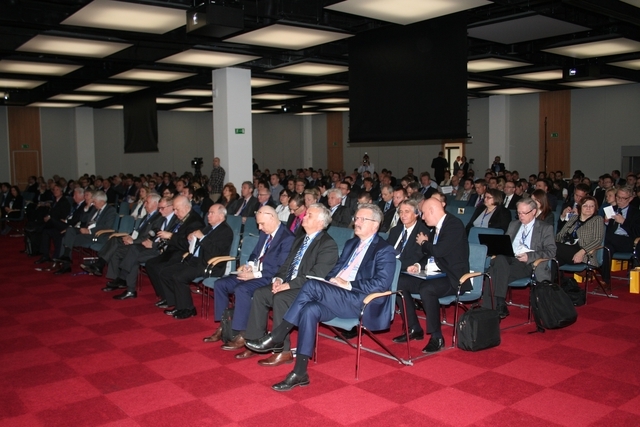
On May 14th and 15th, Poznań became the capital of international logistics. The Polish Logistics Congress LOGISTICS 2014 has begun, which this year is held under the theme “Communication in supply chains”. Yesterday, a few minutes after 10:00 AM, the ceremonial opening of the Congress took place. The 12th edition of this prestigious event, held inside the renovated pavilion 15 at the Poznań International Fair, attracted over eight hundred participants representing both the scientific community and the world of business.
The plenary session was inaugurated by a speech from the Undersecretary of State at the Ministry of Economy, Mr. Dariusz Bogdan, who stated that logistics is the bloodstream of the economy and the foundation of trade.
– Logistics in Poland belongs to those fields that are exceptionally innovative – emphasized D. Bogdan. – Thanks to enterprises and institutions for which this innovation, combined with increased efficiency, is a priority, we can be competitive in foreign markets.
Speaking these words, Minister Bogdan distinguished the Institute of Logistics and Warehousing, emphasizing that among the research units supervised by the Ministry of Economy, the unit led by Dr. Grzegorz Szyszka belongs to the absolute forefront of the best and most innovative ones.
The next speaker, Jos Marinus, President of the European Logistics Association (ELA), presented a presentation in which he focused primarily on contemporary aspects of communication.
– We live in very difficult times, characterized by a huge pace of technological, social, and legislative changes – said Jos Marinus at the beginning. – On one hand, we are now able to track almost everything – planes, ships, and trucks, and even pallets and individual shipments. We know where they are, how they got there, and where they are heading. There is more and more data coming from scanning labels on goods. However, this also has its negative consequences – we are overwhelmed by data and information that we cannot digest or communicate between systems in time.
Therefore, one of the most important challenges of modern logistics – both domestic and international – is to create cross-system platforms that will facilitate the analysis of this data in connection with the entire supply chain, as well as enable efficient communication and, as a result, the appropriate use of the collected data.
– Although transport is one of the most innovative branches of the economy, a field that has no equal in the speed of development, we still face the challenge of eliminating errors that, from the point of view of modern logistics, should not have a place in it – added J. Marinus, presenting data on the use of cargo space in trucks traveling across Europe: on average, it is only 55% of the total cargo space. An additional problem is the high rate of “empty runs” that has persisted for years. According to data presented by the ELA President, every fifth truck carries air instead of goods. This, of course, contributes to traffic jams on the streets, the need to build more road networks, and an increase in carbon dioxide emissions into the atmosphere.
The hope for eliminating logistical errors in transport lies in locally emerging communication platforms, such as the Polish Logistics Technology Platform, which is being created on the initiative of the Institute of Logistics and Warehousing. The ceremonial signing of the agreement between representatives of the world of science and business, inaugurating the creation of the PLPT, took place during the plenary session of the Logistics 2014 congress.
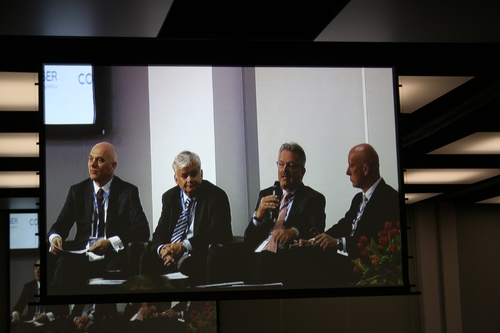
– We want to counteract the problems that plague Polish and European transport. We intend to use the native intellectual and technological potential of the logistics industry and optimize the use of domestic and EU funds for the economic development of our country and transform its economy towards a dynamic and competitive knowledge-based economy – says Marcin Hajdul, Head of the Logistics Knowledge Center at ILiM. – Cooperation between science and business is needed because we can only succeed if we combine educational activities with practice.
This remark was also confirmed by Professor Włodzimierz Rydzkowski from the Department of Transport Policy at the University of Gdańsk:
– We build educational programs based on what we have learned ourselves, what we know how to do, and it is extremely necessary to confront theory with market needs and the actions of the business world – says W. Rydzkowski. – That is why the inauguration of the Polish Logistics Technology Platform is so important, because thanks to it, development will be able to proceed on two tracks and take into account the needs of both sides.
Watching Marcin Hajdul’s presentation and listening to the debate that took place just before the break, one could get the impression that a solution is finally emerging that encompasses the sustainable development of the Polish economy. Thanks to the combination of research work carried out by the scientific community with the needs and actions of companies, it will be possible to lower logistics costs, reduce traffic congestion, increase safety in transport, and improve the quality of implemented processes.
Just after the break, Hans-Christian Pfohl appeared on stage, speaking about the need to compete through cooperation within a network economy and about the four determinants characterizing competitive advantage: relational assets, knowledge-sharing activities, effective management, and the complementarity of resources and capabilities.
Steve Bratt from the GS1 Global Office gave a very interesting presentation, first reminding the audience of the role of global GS1 standards, and then smoothly moving on to discuss the changes taking place in the business world, with particular emphasis on the rapid growth in the number of internet users and online purchases (especially in China). Seamless customer service across physical and digital distribution channels requires a special approach.
– It is necessary to rethink all aspects of business processes and focus on customer service in such a way that it is practically imperceptible and seamless for them – explained S. Bratt.
At the end of the plenary session, the European Logistics Association certificates were traditionally awarded. These are prestigious professional competence certificates in the European Logistics Certification System, which are available at three levels: Junior, Senior, and Master.
The Polish Logistics Congress also features a large logistics exhibition, numerous thematic sessions, workshops, and technical visits to partner companies. It is also a unique opportunity for discussions “across divisions” with representatives of competing logistics companies and leading theorists and practitioners in the industry. It is also worth mentioning that during the congress, the report “Logistics in Poland 2013” was presented, a collective work edited by Grzegorz Szyszka and Ireneusz Fechner, which will be available for sale starting tomorrow on the Biblioteka Logistyka website.
Today is the second day of logistics attractions. We invite you to Poznań!