








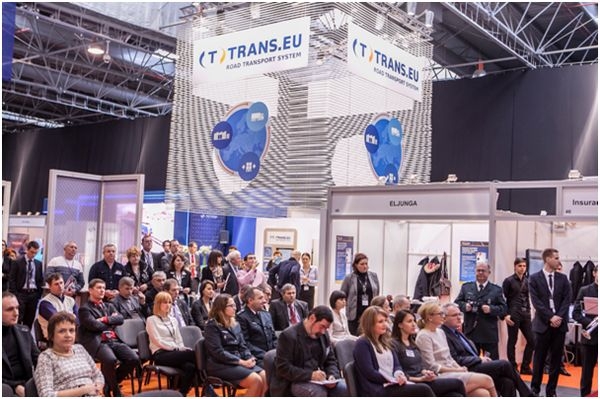
Over 60 exhibitors and more than 2,000 guests, mainly representatives of management staff in the transport and logistics industry, mark the success of the event’s first edition.
Management staff, managers, owners of transport and logistics companies, and heads of the largest state-owned companies in the road, rail, and maritime transport sectors were the guests of the first edition of the International Transport and Logistics Exhibition Trans Poland 2013 in Warsaw. A rich substantive program awaited exhibitors and visitors, starting with a conference organized by the Ministry of Finance on customs regulations for carriers and the development of the E-CUSTOMS program. The second day of the event was entirely devoted to the main theme of the fair, i.e., intermodal transport. The last day of the fair was spent discussing the prospects of the Baltic-Adriatic transport corridor. Guests and exhibitors could also obtain free legal advice on transport and logistics on-site, provided by the best specialists in the industry.
The first edition of the International Transport and Logistics Exhibition Trans Poland 2013 was held under the patronage of the Ministry of Transport, Construction and Maritime Economy. The event was attended by industry representatives from, among others, Russia, Lithuania, Germany, Finland, Italy, the Netherlands, Kazakhstan, Estonia, and Slovenia. The fair also featured the largest Polish companies and representatives of government agencies, including PKP Cargo and the Customs Service.
Dorota Raben, President of the Port of Gdańsk, did not hide her satisfaction: – We are very impressed by the organization of the Trans Poland 2013 fair. We met all the participants of the transport market here, representatives of the world of science and administration. The Port of Gdańsk’s offer aroused interest that even exceeded our expectations. The exchange of ideas during the accompanying industry conferences, conducted at the highest substantive level, was invaluable. We gained new contacts, our potential future clients, and also refreshed relationships with old acquaintances. This event turned out to be a bullseye; we hope to meet at the next fair under the Trans Poland banner, keep it up! – says President Raben.
The event hosted 60 exhibitors from a dozen European countries, and over 2,000 people visited it over three days. The guests were mainly management staff, managers, owners of transport and logistics companies, and heads of state-owned companies in the road, rail, and maritime transport sectors. The event also featured representatives of government agencies; there were representatives of the Ministry of Finance, the Ministry of Transport, Construction and Maritime Economy, the Association of International Road Carriers, and several diplomatic missions.
Says Dorota Kosowicz, PKP Cargo Logistics: – It should be noted that the event is being organized for the first time, and for this reason, I consider it a successful debut. Due to the location of the event in Warsaw, we would like it to be cyclical and have subsequent successful editions that will have an increasing reach year by year. We are open to cooperation in the coming years.
The stand of the Customs Service Department of the Ministry of Finance enjoyed great interest. During the three days of the fair, customs officers provided practical information on customs law issues and conducted interesting discussion panels.
– We are very satisfied with the attendance at the seminar and in the exhibition hall – explains Marcin Woźniczko, Customs Service Department of the Ministry of Finance. – People come to see our mobile scanner, which is a device for X-raying packages and luggage. Anyone can come with their luggage and see what it looks like in X-ray perspective.
The exhibition allowed all visitors to familiarize themselves with the latest products and solutions available in the industry. The subject matter of the fair was mainly devoted to intermodal transport, which has great growth potential and broad development prospects in Poland.
Dorota Kosowicz from PKP Cargo Logistics also drew attention to the main theme of the fair: – The main theme of the event, i.e., intermodal transport, has a future ahead of it. At the fair, many people were interested in this particular branch of our business.
Among the exhibitors of Trans Poland 2013 were companies operating based on intermodal transport issues; transport and forwarding companies (rail, road, maritime); manufacturers of transport rolling stock; manufacturers of parts and components in various transport sectors; manufacturers of internal transport systems and warehouse equipment; and manufacturers of solutions in the field of ITS and transport management systems.
Already on the first day (November 26), a rich substantive program prepared for Trans Poland 2013 started. Representatives of the Ministry of Finance and the Customs Service discussed changes in procedures and customs regulations in trade. Guests also learned about the stage of changes in the E-CUSTOMS Program and what facilities customs officers prepared for businessmen in 2012-2013. Throughout the fair, Customs Service officers advised guests and exhibitors on legal issues. The stand of the Polish Ministry of Finance was very popular with visitors.
The open “Transport Meetings,” which took place daily in the main hall of the fair, met with equally great interest. Transport industry experts discussed, among other things, cost-reduction systems in transport companies, operations in Eastern markets, and provided practical advice for those concluding transport contracts. There were also issues related to insurance in transport and risk assessment in the industry.
The second day of the event (November 27) was devoted to the main theme of the fair, i.e., intermodal. This is an important topic for Polish carriers because the share of intermodal transport in Poland is growing year by year. It was to these issues that the INTERMODAL 2014 conference was devoted: Opportunities and barriers to the development of intermodal transport in Poland – from cooperation to coopetition.
The session on intermodal was opened by representatives of the Ministry of Transport, Construction and Maritime Economy and the Office of Rail Transport. They presented what intermodal transport looks like in the transport policy of Poland and the European Union. Seminar guests also learned about the directions of development and support for intermodal transport in Poland’s policy.
A representative of the Institute of Logistics and Warehousing spoke about the factors influencing the development of intermodal transport, and Dr. Mirosław Antonowicz from the Kozminski University presented the topic “Value for the customer in intermodal transport as a system product”.
Subsequent sessions concerned the role of cluster structures in supporting intermodality and co-modality of transport and intermodal transport in business practice.
On that day, the “Transport Meetings” were devoted to legal changes in transport and logistics. Lawyers discussed legal aspects related to driving and working time standards for road transport drivers. They pointed out, with specific examples, how to prepare a company for an inspection by the Road Transport Inspectorate. The forum also covered topics related to effective company management and activities supporting ecology in transport.
The third, last day of the Fair (November 28) was dominated by issues related to the Baltic-Adriatic transport corridor. Experts discussed the development prospects of this transport route.
The discussion was opened by the Vice President of the Association of Polish Regions of the Baltic-Adriatic Transport Corridor – Marcin Bugajski. The conference was attended by, among others, representatives of the Ministry of Transport, Construction and Maritime Economy, the Maritime Institute, and individual voivodeships. Experts pointed to the benefits resulting from the cooperation of companies and local governments in the structure of the north-south corridor. The importance of the Baltic-Adriatic Corridor for the economy of individual regions and the entire country was emphasized. Potential directions of trade exchange important from the point of view of the Polish part of the corridor were presented: Scandinavian countries, Central and Eastern Europe, and Southern Europe.