









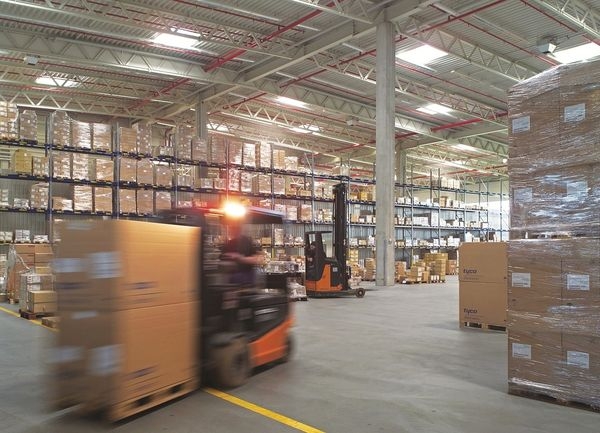
5 warehouses with a total area of 44,000 square meters, approximately 500 employees, and thousands of transported and stored loads. The Kuehne+Nagel logistics center in Hamburg is designed for 24/7 operation. However, besides efficiency, one of the most important ideas behind this facility is ecology – and at the highest level.
Opened in 2009, the warehouse complex is part of a company that has locations in over a hundred countries. However, this massive undertaking is not just a network of warehouses. Great emphasis is placed here on ecological values, which are maintained, among other things, through the use of new technologies, including STILL forklifts.
The center in motion
The construction of the logistics center in the Obergeorgswerder area of Hamburg took a year and cost 55 million euros. The total warehouse area is 44,000 sq. m. In addition to offices, the center houses three types of facilities – contract logistics warehouses, cross-docking terminals, and a container terminal. The task of the former is to manage corporate logistics under long-term contracts. A customs and duty-free zone is located on an area of 25,500 sq. m., and goods are distributed from here regionally, nationally, and continentally. The logistics center in Hamburg is also adapted for rapid handling – 90% of the goods delivered there are transported further within 24 hours. To make this possible, nearly 9,000 sq. m. is occupied by a cross-docking terminal. In this area, goods are reloaded and shipped further without being stored. This solution allows for a reduction in transport costs, but requires 24/7 operation by 150 people working in three shifts. In this way, approximately 490,000 shipments are transported through the Kuehne+Nagel cross-docking terminal annually. The 10,000 sq. m. container terminal is used for reloading goods from various means of transport. Annually, about 40,000 loads are dispatched from this location, which are distributed regionally, nationally, or continentally, among others.
Technology friendly to work and the environment
The huge scale of the project means that the equipment used in the logistics center must meet rigorous requirements. Reliability and durability are among the most important assumptions. The Kuehne+Nagel fleet includes a total of 53 STILL brand forklifts. The specifics of the work performed mean that various types of forklifts are used at the Hamburg logistics center. In the contract logistics warehouses, high-lift trucks are mainly used. Thanks to them, it is possible to store goods at heights, even in narrow warehouse aisles. Meanwhile, for handling the cross-docking terminal, due to the variety of operations performed, not only counterbalanced models are used, but also low-lift pallet trucks controlled by a tiller. The latter can transport goods weighing up to 3 tons without the use of physical force by the employee. Models with increased load capacity are mainly used for unloading trucks. At the beginning of this year, the Kuehne+Nagel fleet was joined by the premiere STILL RX 70 60-80 models.
– This truck can carry goods weighing up to 8 tons, while being the most maneuverable in its class – explains Paweł Włuka, Marketing Department Manager at STILL. – It is also characterized by low fuel consumption, partly thanks to the Blue-Q program, which allows for consumption optimization by turning off unnecessary power consumers, thereby saving 10% of energy. At the same time, during acceleration, there is an automatic shift to the next gear. This allows for a 25% reduction in engine speed while maintaining driving speed – the expert adds.
In addition to introducing changes in internal transport, rules applicable to external carriers were also established. The application of standards in logistics processes at all levels – from warehousing to land and sea transport – aims to create a model that is environmentally neutral. Great emphasis was placed on training drivers who are responsible for economical driving. Aerodynamic, double-deck vehicles are also preferred. They also use so-called downsizing, which allows for a reduction in engine displacement, thereby reducing the amount of fuel consumed while maintaining power. All these actions serve to maintain work efficiency.
A building with principles and a concept
The basic idea according to which the Kuehne+Nagel logistics center investment was realized was ecology. Therefore, it was planned as early as the design phase that by 2020, electricity consumption would be reduced by 20% and carbon dioxide emissions by 15%. In the case of fuel burned for the center’s needs, its quantity is to fall by 1% each year. One of the assumptions is also the responsible use of water and reducing its consumption. To meet these requirements, it was decided to use the latest technologies in daily work and to invest in simple, environmentally and employee-friendly solutions. Fluorescent, long-life lighting is intended to reduce electricity consumption. Solar collectors installed on the roof have similar advantages. Furthermore, the building is equipped with devices that allow for energy recovery from ventilation and the reuse of rainwater. Around the center, there is also a green area of 24,000 sq. m., where almost 12,000 trees and shrubs have been planted.