








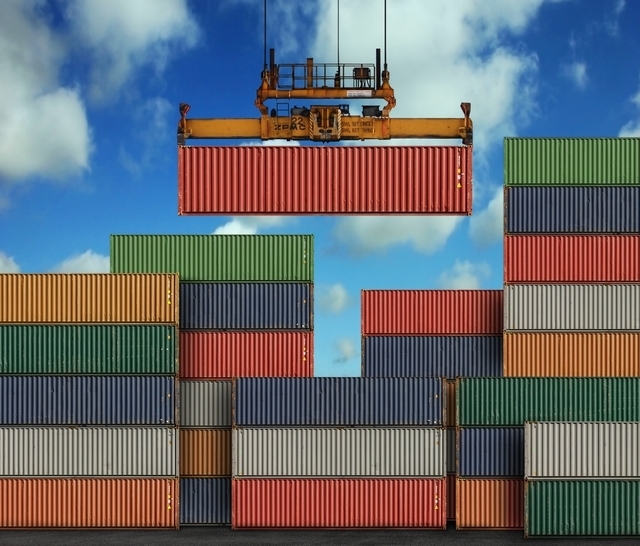
The beginnings of cargo containerization in transport took place in the USA and coincided with the years when transshipment points became a bottleneck for international transport. In the 1960s, along with the economic boom, the volume of goods subject to foreign trade increased.
Seaports began to experience difficulties in terms of fast and efficient transshipment. This applied to both transport means and cargo, which were being delivered to destinations in increasingly longer times.
To reduce the enormous mass of small, minor cargo lots requiring costly and time-consuming transshipment and storage handling, the concept of “enclosure modules” load units was created, allowing for the acceleration and simplification of these operations. The result of these considerations was containers, initially operated in “port-to-port” relations, and later also in “door-to-door” relations. Following maritime transport, containerization became a permanent part of land transport. In Europe, containers appeared at the end of the 1960s – in April 1966, the s/s Fairland arrived in Europe from the USA, carrying 226 containers on board – since then, the process of containerizing load units has been ongoing in Europe. In 1968, Technical Committee 104 of the International Standardization Organization (ISO) developed a definition of a container, i.e., a transport device meeting the following characteristics:
-
of a permanent character, strong enough to be suitable for repeated use;
-
designed to facilitate the transport of goods by one or more modes of transport, without the need for reloading the goods;
-
equipped with devices that ensure ease of securing and handling – especially during transshipment from one mode of transport to another;
-
constructed in a way that allows for easy loading and unloading of goods.
In the same year, the technical parameters of containers were standardized on a global scale, with the main emphasis on: standardizing their dimensions, determining the maximum gross mass, specifying the construction of containers and their strength, as well as marking. Due to external dimensions, we divide containers into: 20-foot, 40-foot, and 40-foot High Cube. Containers, due to their dimensions and structural properties, require transport means appropriately adapted to their carriage, ensuring fast loading and unloading as well as their safe transport. (…)
The article contains 17,093 characters.
Source: Logistyka Magazine 5/2012
Overloading problems in road container transport – PDF file for download