










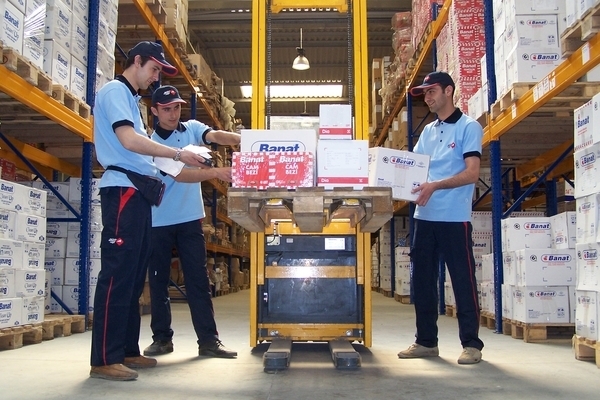
Order picking and issuing materials in accordance with customer orders is a fundamental process that influences the quality of services in a distribution warehouse. One of the criteria for assessing quality is the order fulfillment time.
From the customer’s point of view, this time is calculated from the moment an order is placed and confirmation of its acceptance for fulfillment is received (order fulfillment phase). All other activities in the warehouse, which make up the preparatory phase, are subordinate to the fulfillment phase and are not significant from the customer’s perspective. The cost of carrying out the preparatory phase will affect the cost of the service for the customer, however, this phase should not affect the order fulfillment time (e.g., lack of materials in the warehouse preventing the fulfillment of current orders). For this reason, particular importance is attached to the design of picking areas in warehouses. Errors made in this regard and delays resulting from the inefficient operation of these areas translate into the level of customer satisfaction, which will affect the demand for services.
Picking areas in the warehouse have locations with the best access features. A large number of assortment items (a.i.) are represented in them on a relatively small area, thanks to which free access to individual pieces of material and the fulfillment of customer orders is possible.
For this reason, they are the most expensive to maintain and manage, and at the same time, they are crucial for the functioning of distribution warehouses.
2. Configuration of picking areas
2.1. Basic concepts
The picking process is carried out in the picking areas of a distribution warehouse. This process begins with the division of customer orders into so-called lines, which contain information about how many pieces of a given assortment item must be picked to fulfill the order. An assortment item (a.i.) is a specific type of material handled in the warehouse and is described by a unique identification number. The number of a.i. handled in the warehouse depends on its business profile.
Picking areas consist of a specific number of locations, i.e., places where materials are offered, with a known capacity and described by a unique address. Locations have a fixed place in space. In a single location, one type (item) of assortment is offered. The implementation of the picking process consists of the employee moving between locations where materials described in subsequent order lines are picked. (…)
The article contains 33,802 characters.
Source: Logistyka Magazine 4/2012