








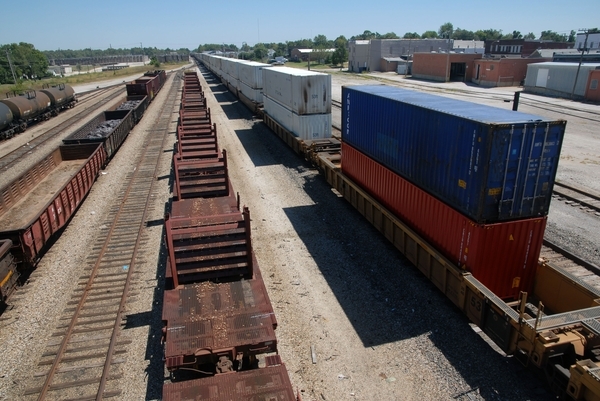
Intermodal transport is usually defined as a type of carriage where the largest part of the journey is carried out by rail, inland waterway, or sea, and the initial and/or final leg is performed by road transport, which is as short as possible.
According to the UN combined transport glossary, intermodal transport is the movement of goods in one and the same loading unit or vehicle by successive modes of transport without handling the goods themselves when changing modes. All of this should constitute a single transport system (chain) that requires an integrator, cooperation, collaboration, and partnership of all links involved, regardless of the number of links involved in the transport. The system must be viewed as a whole according to the principle of holism, assuming that its proper functioning is maintained when there is consistency in the goals and motivations of all its participants. In specific transport chains, logistics operators and combined transport operators can act as integrators in the development of intermodal transport and as those setting strategic goals.
In 2011, the Institute for Civil Affairs initiated a marketing promotional campaign titled “Trucks to Trains” with a conference featuring representatives from Switzerland. The participation of representatives from Switzerland—a country oriented towards ecology and utilizing intermodal transport in practice while supporting its operation with public funds—serves as a specific benchmark to follow. Especially since the Swiss have designated a significant place for rail in freight transport through the Alps in their constitution (Art. 84) and consistently adhere to it. A subsequent seminar summarizing the promotional campaign with examples took place at the end of 2011, this time utilizing the experiences of Austria. For many years, intermodal transport in Poland has been treated as a development segment, and in European Union policy, it is one of the most supported forms of transport. From a marketing perspective, it is a relatively young market, yet its share in the rail transport market is small.
The share of rail in intermodal transport by mass at 1.7% and by transport performance at just under 4% clearly indicates how much effort and time is still needed to reach the EU average level, which oscillates around a 17% share in the volume of goods transported by rail. Incidentally, the strategic goal outlined in the Strategy for Transport until 2020 project points to Poland’s aspiration to reach the average level for European Union countries from 2000 by 2020, i.e., 10-15% in terms of mass.
The article contains 19,640 characters.
Source: Logistyka Magazine 4/2012
Marketing perspective on intermodal transport involving rail – PDF file for download