








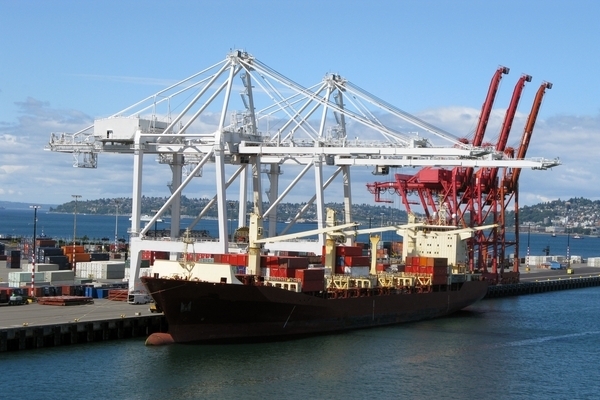
The growing demand for containerized cargo transport forces shipowners to build vessels with higher capacity. This causes ports that are not adapted to handle large ships to be forced to modernize their port infrastructure, build new quays, and deepen approach channels, canals, and port basins. The scope of reconstruction, the size of the maximum ship that will be able to call at the port, the window of permissible weather conditions, and the required power of port tugs are determined.
The most difficult task is to ensure adequate space for performing ship maneuvers inside the port, primarily water areas with dimensions that allow for turning the ship. Maneuvering procedures for turning the ship using turning basins and port basins adjacent to the turning basin are taken into account. Computer simulation is used to verify design assumptions regarding the reconstruction and expansion of the maneuvering space. Decisions regarding reconstruction are made based on the safety assessment of the ship with maximum parameters for the designed infrastructure.
The article proposes a safety assessment of critical maneuvers – those decisive for the success of port operations of a maximum ship, based on risk analysis using Bayesian networks. The Bayesian network and Bayesian influence diagrams used for risk assessment are presented using the example of the Port of Gdynia. Currently, vessels with a length not exceeding 280 m and a draft not greater than 13 m can be brought into the port of Gdynia. Shipowners operating in the Baltic Sea are planning to introduce into service a larger number of ships than currently exist with dimensions exceeding the parameters of the maximum ship for this port. This forces the Port of Gdynia Authority to consider modernizing its existing infrastructure.
The article contains 15788 characters.
Source: Logistyka Magazine 4/2012