








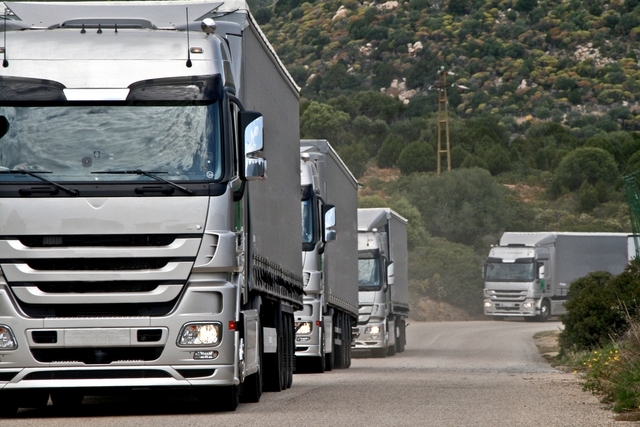
The decision to allocate tasks to available resources is a problem faced by every enterprise. The diversity of transport companies necessitates different approaches to the allocation problem. The nature of the company determines the type of tasks performed.
In a public transport company, a transport task can be defined as the carriage of passengers on a specific transport line. The allocation problem in this case is the selection of vehicles for individual lines, taking into account constraints such as maximum passenger flows on a given route or a specific timetable. In a transport company, a transport task can be defined as the carriage of cargo from a pick-up point to a delivery point. It should be noted that tasks begin and end at different time intervals. During one departure from the base, while carrying out one planned route, a vehicle can perform several assigned tasks. The allocation problem in this case is to direct vehicles finishing their current tasks to the next tasks in such a way that the total sum of approach segments to individual tasks is minimal. Assuming that a transport task can be represented graphically as two vertices of a bipartite graph: the first vertex is the loading point and the second is the unloading point, the allocation problem can be defined as finding a suitable match between the end point of the current task and the start point of the next task so that the allocation generates a minimal route that, of course, meets the time constraint conditions. Time constraints include a specific arrival time at the pick-up location, a specific cargo delivery time, loading and unloading duration, and daily driver working hours are also taken into account.
The article contains 14,520 characters.
Source: Logistyka Magazine 4/2012
Resource allocation model for tasks in a transport company – PDF file for download