










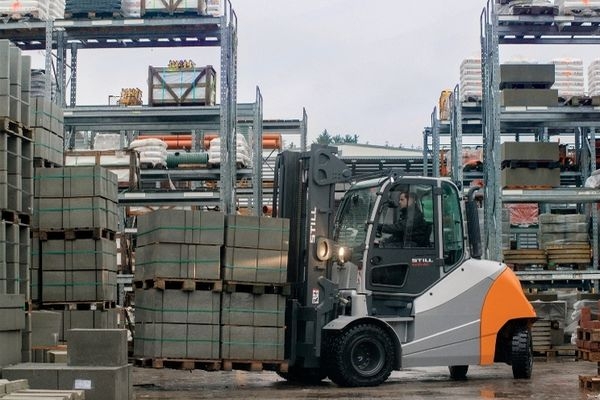
The use of high-capacity forklifts in heavy industry has always been a popular solution. Alongside overhead cranes, classic counterbalance forklifts and four-way forklifts are becoming essential tools for maintaining logistics and production processes.
High temperatures, particularly heavy loads, and high dust levels mean that forklifts used in heavy industry must be specifically adapted to harsh conditions. What solutions are used to adapt them to the specifics of the work while ensuring safety?
Industry requirements
The primary factor influencing the ability to use a forklift in heavy industry is its load capacity. To meet industry requirements, it must be at least 5 to 8 tons, and often even more. It is also important for the forklift to feature precise control of driving and lifting systems, which ensure ergonomics and comfort in conditions requiring maximum accuracy. Due to the vehicle’s own dimensions and the aisle width (AST), the maneuverability of the forklift is also significant.
– In the case of forklifts used in heavy industry, the residual capacity of the truck, which depends on the dimensions of the load, the attachments used, and the lifting height, is also of significant importance. Capacity is increased at high lift heights by integrating attachments with the mast or by factory-weighting the truck – explains Marek Schwarz, Director of the Katowice Branch at STILL Polska.
Due to the vehicle’s curb weight and dimensions, the amount of fuel consumed can increase significantly. The use of a diesel-electric drive allows for relatively low fuel consumption while maintaining maximum efficiency. This solution allows for complete independence of the driving system from the lifting system, ensuring optimal parameters for the user. An additional solution that makes the forklift’s operation more economical are programs that optimize the work of electrical consumers, such as the Blue-Q energy and fuel consumption management system from STILL. Programmed to the user’s needs, the system manages energy intake. Thanks to it, unnecessary power consumers are temporarily switched off, which allows for energy savings of up to 10%. To optimize costs, it is also worth ensuring the reduction of wear and tear on individual parts of the forklift. This is served by, for example, transferring torque to the electric drive motor via a conventional transmission, without the need for maintenance-intensive oil transmissions.
Proper fit
Overhead cranes or hoists in the steel industry are not enough to optimize internal logistics processes. Forklifts are used for the transport and loading of heavy, small-sized products and semi-finished products. Counterbalance and four-way models are used mainly during steel packaging and processing.
– To adapt a forklift for work in conditions of elevated temperature and significant load, a so-called foundry execution is used – explains Marek Schwarz. – Thanks to it, protection for the operator and the machine is obtained, for example, against contact with liquid metal and the short-term impact of high temperature on the forklift’s components.
Four-way forklifts are used for transporting long loads, while counterbalance models are used for transporting homogeneous products with dimensions not exceeding 3 meters in length and width. To optimize work, as in other industries, additional equipment is also mounted on the forklift. The most frequently chosen are positioners, jibs, ladle grabs, and vision systems. At the same time, industry requirements mean that forklift users increasingly expect equipment manufactured to individual orders.
A steel truck for steel
The difficult conditions prevailing in metal industry plants mean that forklifts must simultaneously meet additional requirements. The safety of the operator and the machine is ensured by using, for example, thermal shields for front axles or tires. Elements made of non-flammable materials also allow for risk reduction. It is important, both due to the European Union directive 97/68/EG and the increased amount of dust in heavy industry plants, to reduce the content of harmful particles emitted by the forklift. Exhaust catalysts and particulate filters, e.g., for soot, are used for this purpose. Engines are also subject to dust protection. To shield the machine from metal splinters, additional covers on the mast, leather aprons or rubber sleeves, as well as special mats are used. When operating a forklift in heavy industry plants, special attention should also be paid to the way the machine is used. First of all, one should ensure the designation of forklift traffic routes with simultaneous separation of pedestrian paths. In these vehicles, maneuverability is of huge importance, as well as the aspect of work safety, so that the operator has good visibility in every direction. At the same time, while taking care of work comfort and the ergonomics of the operator’s station, manufacturers use noise-absorbing and vibration-reducing solutions in these types of trucks (full cabins, damping mats, personal protective equipment for operators).