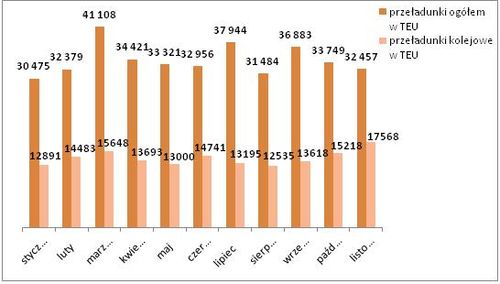
The Baltic Container Terminal in Gdynia broke its previous intermodal record in November 2012, handling as many as 17,568 TEU at its rail terminal. The share of rail transport last month accounted for 54.1 percent of all containers handled at BCT. In total, 32,457 TEU were handled at the Baltic Container Terminal in November, and 377,177 TEU since the beginning of 2012.
– We are aware that intermodal transport represents a future-oriented direction for the development of transport. According to the Transport White Paper, by 2050, 50 percent of all goods are to be shifted from road to alternative modes of transport, including rail. The BCT example confirms that this is possible even in Poland, where the average share of intermodal transport currently stands at between three and five percent – said Piotr Frąckowiak, Intermodal Manager at BCT.
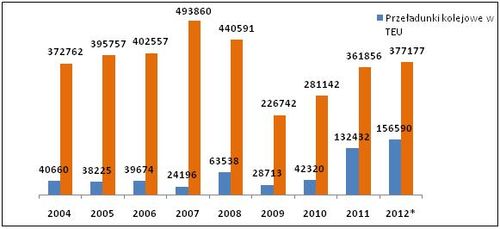
The Gdynia-based company BCT is a leader among Polish terminals in terms of rail utilization for container handling. The share of rail has been systematically increasing since 2010, as shown in the chart below.
Share of rail transshipments at BCT Gdynia in the years 2004 – 2012* (January-November)
Achieving such a high result was possible thanks to the constantly increasing number of rail connections with terminals within the country and on the Baltic-Adriatic corridor. In May of this year, BCT signed an agreement with an international operator, Baltic Rail, whose connection from Gdynia to Dąbrowa Górnicza, and currently to Sławków, operates twice a week. It constitutes an important step towards the implementation of the European Baltic-Adriatic transport corridor concept. In 2012, the company’s client base was also joined by Polzug, which launched a regular connection from Poznań to Gdynia. In recent months, BCT has expanded its range of services to include the transshipment of semi-trailers onto rail wagons, and since November, it has also been handling a regular connection with Warsaw, operated by ATC Rail and Cargosped.
The transshipment capabilities using rail at BCT will continue to grow in the coming years. By 2015, the terminal will complete the largest investment program in its history, as part of which it will increase the terminal’s intermodal potential and, thanks to investments by the Port of Gdynia Authority, modernize its rail terminal. The program, worth over 153 million, is one-third financed by European Union funds, as part of a competition settled last year by the Centre for EU Transport Projects.
BCT Gdynia results in 2012