








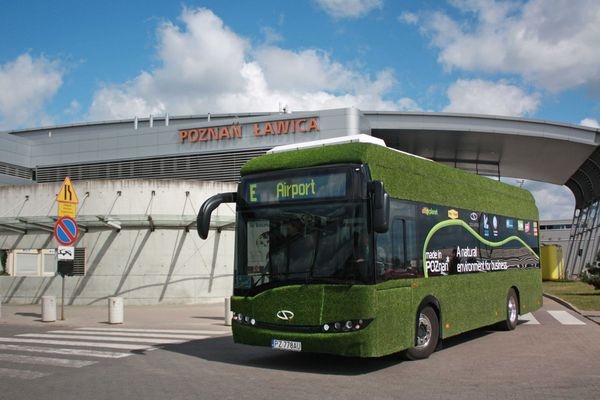
The first round of tests for the Solaris Urbino electric bus in regular urban traffic has been a complete success. Over three weeks of trials, the vehicle covered 3,000 km without any issues, transporting fans and guests arriving in Poznań during the UEFA European Football Championship.
The zero-emission vehicle, quietly traversing the streets of Poznań, drew attention with its appearance, which referenced the Euro 2012 theme—it was covered in artificial grass, fitting into the atmosphere of the Championship. For 22 days, the Solaris Urbino electric transported passengers from Poznań-Ławica Airport to the city center, allowing fans arriving in the city to get a close look at the most innovative solutions from the Polish manufacturer. Thanks to fast-charging technology used between peak hours, the 150 km range of the electric Solaris was not a limitation. The energy reserve allowed for covering a much greater number of kilometers in daily urban traffic.
The Urbino electric confirmed its reliability, and there is nothing standing in the way of it joining any vehicle fleet and entering service in regular urban traffic. Having already obtained full homologation, it can be approved for passenger transport without any restrictions compared to buses with traditional propulsion.
The bus operating in Poznań was the second such vehicle offered by the Solaris company. Like the prototype presented in the autumn of 2011, it was built on the basis of the low-entry Solaris Alpino 8.9 LE. The drive system was supplied by the German company Vossloh Kiepe, which specializes in electric drives and has been collaborating with Solaris in this area for many years. The traction motor power is 120 kW, and the battery capacity is 120 kWh. A new solution applied in the vehicle was the fast-charging system, enabling the charging of completely depleted batteries (at 100 kW power) in just 90 minutes.
Further work on the vehicles means subsequent changes and innovations. While the two prototype electric buses will be undergoing tests in various European cities in the coming months, the company is already working on a new 12-meter electric Urbino. There are also plans to build an articulated version to complete the ecological offer for urban carriers from all over Europe.
Flexibility in adapting to the requirements related to vehicle operation is the result of the modular design of the electric system. The Vossloh Kiepe technology easily adapts to different bus lengths. It is also adapted to automatic fast-charging systems, such as inductive power supply. Thanks to this, batteries can be charged both on the route and at stops, as well as at so-called bus loops, contributing to a significant improvement in vehicle functionality and eliminating any problems related to the range of electric buses.
The innovation of the Solaris Urbino electric has been appreciated and awarded by industry specialists. Readers of the German magazine “Busplaner” recognized the vehicle as the “Innovation of the Year 2012” in the Public Transport category. In turn, the jury of the Transexpo trade fair awarded it a Gold Medal for the best product of 2011.
Like other Solaris brand vehicles, the electric bus was manufactured in the company’s factories in Środa Wielkopolska (steel structure) and Bolechowo (final assembly). In addition to the aforementioned drive system, all other key components also come from leading, reliable European suppliers, well-known to all carriers. Electric mobility has been a daily reality for Solaris for over 10 years. As a leading manufacturer of trolleybuses on the European market, also offering the widest range of hybrid-drive buses, it possesses significant experience in the field of electric drives and their use in urban vehicles.