










Sun Tzu and Sun Pin were not only insightful theorists of the art of war, who also addressed selected issues of military logistics in their treatises, but above all, they were commanders who achieved significant military successes. In the war between the states of Wu and Chu, Sun Tzu, for example, used inland water transport to move his troops during the campaign that was to decide the fate of the war.
He transported his army by boat for 300 km up the Huai River, to the point where it approaches the Hanshui River (506 BC). When two Chu armies attempted to attack him concentrically, he withdrew inland, where he lured them into an ambush and completely destroyed them at the Battle of Bai ju.
The Chinese Army
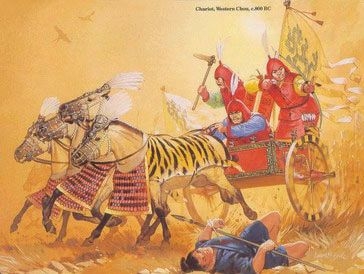
The basis of the field army during the reign of the Qin and Han dynasties and in the later era were tactical units formed from infantry, cavalry, war chariots, and crossbowmen. The core of the armed forces remained heavy, armored infantry, although over time, the cavalry began to play an increasingly important role. Chariots gradually lost their role as assault weapons and increasingly began to serve as mobile command posts towering over the battlefield, from which senior commanders directed the fighting of their units.
The basic armament of most soldiers, both infantry and cavalry, was a spear with a bronze or iron head. A sword about 90 cm long served as a secondary weapon. Everyone, except for light-armed skirmishers, wore armor made of small metal plates (usually bronze), fastened with rivets to a quilted fabric tunic.
Crossbowmen played an important role in the Chinese army, armed with technically advanced crossbows – a weapon that the Chinese used widely a thousand years earlier than the Western world. Everything indicates that it was the crossbows that decided the Chinese victory in the semi-legendary battle with the Romans, which was supposed to have taken place in 36 BC in Sogdiana.
In the 3rd century BC, the Chinese invented gunpowder, but did not use it for military purposes until the 14th century. The pinnacle of ancient Chinese fortification art was the Great Wall, erected along the northern border of the state, initially about 2,100 km long, which was intended to protect it from the invasion of nomads. After the expansion of the wall by rulers of subsequent dynasties, its length increased to as much as 6,000 km.
The article comes from the magazine “Logistyka” 5/2011.