










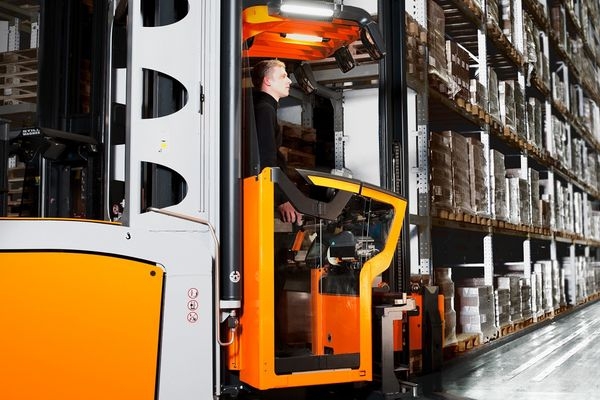
Rising warehouse space costs and the need to increase the efficiency of logistics processes mean that pallet unit storage is taking place at increasingly higher levels. As racks climb higher, forklifts are keeping pace.
High-bay warehouses are designed for storing large quantities of stock within a limited volume. Their maximum height is a derivative of many factors, including the type of goods and their packaging method, the load-bearing capacity of the rack structure, and the hardware capabilities of internal transport equipment. Traditional forklifts, adapted for operation at heights of several meters, do not pass the test here. Highly customized equipment for order picking at levels of up to 15 meters is essential.
Maximum efficiency
High-bay warehouses are increasingly becoming 24/7 distribution centers. Fully automated and controlled by advanced IT systems, they become so reliable that the continuity of logistics processes is the foundation of their operation. Technology, not humans, is responsible for tasks such as inventory recording, delivery preparation, or forklift control. A laser identification system allows for precise monitoring of the route of internal transport equipment, and additionally, integrated with the material flow system, it enables ongoing control of all loads throughout the entire supply chain. Excellent precision in the operation of warehouse technology machines is achieved through automatic control using an induction loop placed in the floor and 360° laser sensors that identify racks and pallets.
– In order to increase the efficiency of high-bay forklifts, systems are used to optimize their speed depending on the operating mode. For example, the MX-X truck recognizes the height of the forks and the weight of the load and slows down or accelerates to ensure maximum efficiency while maintaining safety – says Przemysław Wlazeł from STILL Poland.
Safe height
Despite significant benefits, high-bay warehouses also carry certain risks. Limited space and extensive infrastructure mean that a potential accident, fire, or failure has more extensive consequences. Therefore, to minimize the threat, particularly strict rules and modern technologies are used here to increase work safety. Proper organization of rooms, appropriate employee clothing, marking of evacuation routes, or the installation of fire detection and extinguishing systems – safety in the warehouse depends on compliance with OHS regulations. Infrastructure adapted to working conditions also plays a significant role in preventing threats: racks with reinforced load-bearing structures and high-bay storage systems, which are increasingly based on automation. The reliability of technology means that manual control mode is used only sporadically. Modern forklifts move autonomously along designated paths in the warehouse, analyzing and recognizing the environment. This means they can adjust speed to the type of surface, distinguish rack heights, and identify unexpected obstacles. Advanced path programming technology also allows for optimizing the vehicle’s travel speed: the vehicle will stop dynamically at the end of an aisle, and when changing aisles, an assistance system will ensure safety and avoid collision with the rack. However, it should be remembered that even with so many factors maintaining passive safety, equipment damage can occur due to operator negligence. In such cases, due to the individualism in equipment selection, it is difficult to find a replacement machine during the repair time – which is why a quick response from professional service is so important to restart the truck in the shortest possible time.