











Increasing environmental protection requirements for enterprises mean that environmental efficiency analyses in logistics are becoming as important as the cost-effectiveness of managing logistics processes. Production logistics, as one of the fundamental logistics processes, takes into account the flow of raw materials, materials, energy, and information in the production sphere. It is directly related to the technology of manufacturing specific products for the end customer.
The article presents the essence of assessing economic and environmental aspects in this logistics process. The aim of the article is to present the importance of eco-efficiency analysis in production logistics. Life Cycle Assessment (LCA) was proposed for environmental analysis, and Life Cycle Cost (LCC) analysis for assessing economic efficiency. The LCA enables the inclusion of environmental aspects in all phases of a product or technology life cycle, from the acquisition of raw materials, through the production, transport, and usage phases, to disposal (end-of-life related to waste management or landfilling). LCC, on the other hand, allows for the inclusion of costs throughout the entire life cycle, and the system boundaries cover the same scope as for LCA analyses. By combining environmental and economic analyses, it is possible to determine the eco-efficiency of selected technologies, processes, or products.
Linking eco-efficiency and the logistics approach
The integration of logistics processes in the supply chain is the domain of modern logistics. Integration trends related to: the development of flexible production systems, building close cooperation with supply chain links, and the development of IT integration in controlling demand flow streams, contribute to increasing the efficiency, effectiveness, and transparency of the flow of goods, services, and information. Obtaining a competitive advantage in a rapidly changing market economy also means perceiving the integrated supply chain in terms of sustainable development. Taking into account the production supply stream coming from recovered products enables closing the loop in the supply chain while maintaining a balance between minimizing logistics costs and fulfilling tasks related to environmental protection. Despite this, few studies are currently being conducted aimed at integrating the management of logistics processes with eco-efficiency, which is a measure of the balance between environmental impact and economic results. The concept of eco-efficiency enables the delivery of competitive products that meet customer needs with a limited environmental impact throughout the entire life cycle. Only a holistic approach to logistics systems will enable a balance between economy and environmental impact to be achieved. Until now, most logistics-related activities focused only on assessing economic efficiency. Environmental aspects were completely ignored. Over the years, as attention began to be paid to the importance of the impact of enterprises on the environment, resource consumption, and sustainable development, environmental aspects were also included in logistics, one of the primary effects of which was the implementation of reverse logistics.
When conducting a comprehensive assessment of each production process, economic, technological, and environmental issues must be considered simultaneously. Such an approach is enabled by eco-efficiency analysis, which was defined by the World Business Council for Sustainable Development (WBCSD) in 1991 as delivering competitively priced goods and services that satisfy human needs and bring quality of life, while progressively reducing environmental impact and resource intensity throughout the life cycle. According to the “US President’s Council on Sustainable Development” report, eco-efficiency was defined as maintaining economic growth with minimal environmental impact, using limited amounts of non-renewable resources, and reducing waste, creating a healthy living environment for all humanity.
The Organisation for Economic Cooperation and Development (OECD) defines eco-efficiency as linking economic and environmental efficiency to meet customer needs and defines it as the ratio of customer value to environmental indicators. According to the European Environment Agency (EEA), eco-efficiency is a key concept for enterprise management in the pursuit of sustainable development.
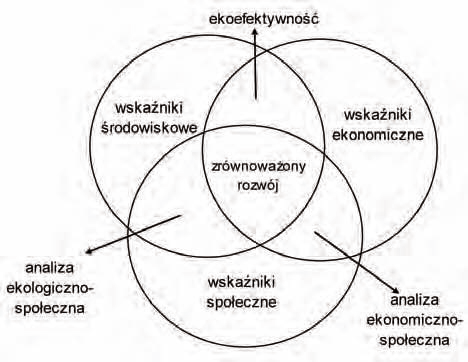
The World Business Council for Sustainable Development (WBCSD) identified 7 elements for an enterprise to increase eco-efficiency: reduction of material consumption; reduction of energy consumption; reduction of toxic substances; increase in recycling; increase in the share of renewable substances and renewable energy sources; increase in product durability; increase in product value. Eco-efficiency analysis integrates two of the three elements of sustainable development – economic and environmental (Figure 1).
The article comes from the “Logistyka” magazine 5/2011.