










Adequate tools and technologies
Work has currently begun on developing legal solutions that will create conditions for the successive implementation of smart metering. In parallel, work is being carried out by PSE Operator, aimed at determining the global benefits of implementing smart metering and developing an optimal model for implementing such systems. Preparations are also underway for the implementation of a project supported by the National Fund for Environmental Protection and Water Management, “Smart Energy Grids,” which will serve as a financial instrument for implementing state-of-the-art grid solutions that increase energy efficiency on a national scale. The technological, as well as ideological, revolution is illustrated by the “backbone” proposed by T. Kowalak, Director of the Tariff Department at the Energy Regulatory Office (URE) (Figure 3).
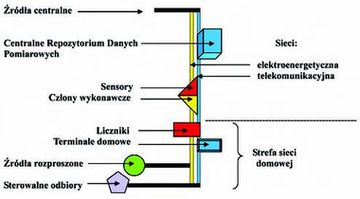
Figure 3 presents 2 grids on which various devices are suspended. The system is characterized by openness to distributed sources, and meters are communication centers rather than electronic collectors. The distribution network must be equipped with bridging systems, and not just meters, but also sensors. Dynamic management of such transmission and distribution networks (Figure 4) is enabled by technology generally referred to as Smart Grid, which is based on measurement and control points (meters, circuit breakers, switches, recorders) located at many nodes and links. Smart energy grids are comprehensive energy solutions that allow for the connection, mutual communication, and optimal control of previously distributed elements of energy infrastructure – on the side of both energy producers and consumers – which enables the mutual exchange and analysis of information, and consequently, the optimization of energy consumption (thermal, electrical) or, for example, gas distribution. To make an energy grid “smarter,” an energy company invests in solutions offered by various manufacturers, such as Substation Automation (SA), Distribution Automation (DA), Smart Metering, Demand Side Management (DSM), Renewable Energy Resource Management, and the like.
An energy company, in particular a distribution system operator, can use various tools and technologies to improve the overall quality of energy services through appropriate management of, for example, technical losses or distributed energy generation. Examples include ICT tools that automate the control of energy flows and the restoration of the power grid after a failure (resulting, for example, from overloading, broken wires, transformer failures, or disturbances caused by lightning strikes) in a way that minimizes power outages.
The implementation of smart meters and Advanced Metering Infrastructure (AMI) is often considered the first step towards a Smart Grid. The number one topic on the lips of the entire power industry in Poland is Smart Metering, i.e., a smart metering system. It enables energy operators to measure energy quality in external network areas, which in turn facilitates the prediction of energy demand with high temporal and geographical accuracy, the management of distributed renewable energy generation (solar or wind), and the verification of the network’s operational status by sending queries to meters (“pinging”). It also allows for responding to changes in demand where consumption is limited or devices are turned off during peak periods. Smart meters allow for measuring electricity, voltage, and power consumption in various areas of the grid (at private, industrial, and commercial consumers, and at substations) and for various purposes (setting tariffs, demand optimization, etc.). Smart home meters have many applications: reading consumption, CO2 emissions, tariffs, etc.
Smart meters can also be considered in the context of energy efficiency, as various players, for example, retail energy suppliers and telecommunications operators, are preparing or already offering their customers services related to electricity (e.g., visualizations, reports, analyses, consulting, etc.) using data collected by, among other things, such meters. Usually, the role of the distribution system operator is to collect accurate and up-to-date measurement data in real-time and make it available to various entities. Furthermore, some retail energy suppliers install additional meters in homes to collect and store data independently of the distribution system operator.
The article comes from the magazine “Logistyka” 5/2011.