








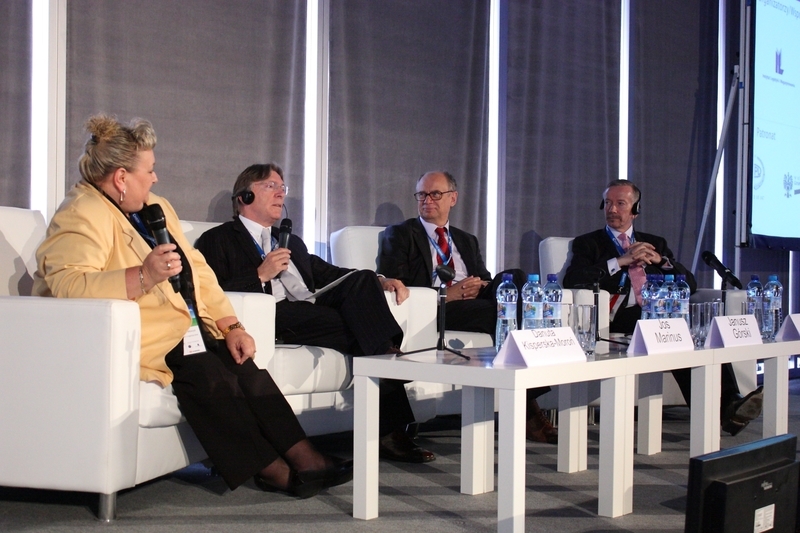
From May 16-18, Poznań hosted the 11th Polish Logistics Congress LOGISTICS 2012 – the largest meeting of logistics professionals in Central and Eastern Europe, organized by the Institute of Logistics and Warehousing. For 20 years, the LOGISTICS congresses have served as a unique platform for exchanging experiences and initiatives, a fact consistently highlighted by its participants. This year’s event, which included plenary sessions, thematic sessions, company site visits, and workshops, brought together 700 representatives from business, science, administration, and the media.
The first plenary session was inaugurated by a speech from the Undersecretary of State at the Ministry of Economy, Mr. Dariusz Bogdan, who pointed out, among other things, the 17% growth recorded by the Polish economy last year, compared to the EU average of 0%.
Jos Marinus, President of the European Logistics Association (ELA), emphasized that this year Poland is hosting two major events – the LOGISTICS Congress and the EURO 2012 football championship.
During the proceedings, participants heard presentations from Grzegorz Szyszka, Director of the Institute of Logistics and Warehousing; Hans Christian Pfohl, Professor at the Technical University of Darmstadt; Janusz Górski, CEO of Schenker Sp. z o.o., and Monika Pachniak-Radzińska, Business Development Director at Schenker Sp. z o.o.; and John Keogh, Director of Product and Consumer Safety at GS1 Global Office, who presented both the challenges facing logistics and the corresponding solutions arising from the need for sustainable economic development. Immediately following the plenary session, Congress participants took part in a debate dedicated to the main theme of this year’s Congress: “sustainable logistics”.
What is this “sustainable logistics”? It is primarily about initiatives and actions resulting from a widespread understanding of the need to consider the necessity of rational natural resource management when defining one’s own business goals, as well as recognizing social needs and conditions (including broadly understood safety) as key priorities. Sustainable logistics is not just about meeting the expectations and requirements imposed, for example, by European Union regulations, but above all, it is a natural direction for the development of every enterprise that wants to compete in the local or global market in a responsible and forward-looking manner.
Grzegorz Szyszka, Director of the Institute of Logistics and Warehousing, mentioned this during the presentation of the report on the state of Polish logistics, adding that our country faces major challenges related to creating a sustainable logistics system.
Professor Hans Christian Pfohl presented issues related to “lean” logistics as an emerging global trend.
– The primary goal of Lean Management is to increase efficiency by eliminating waste in business processes – said H. Ch. Pfohl. – Efficiency is the proper execution of tasks leading to much more focused processes, fewer unnecessary activities, and reduced resource consumption.
More importantly, Lean Management, as understood by Professor Pfohl, is largely dependent on the people themselves.
– The greatest impact on the success of “leaning” logistics comes from employee engagement and their readiness for change. Employees know the flaws and inefficient processes best, which is why Lean Management uses teamwork and employee experience to continuously improve quality and eliminate waste – concluded Professor Pfohl.
Considering social and environmental conditions should not only mean limiting the negative effects of logistics activities but should also result in solutions that improve work comfort, as could be seen during the presentation on sustainable development at DB Schenker.
– At Schenker, we place great importance on sustainable development throughout the supply chain and on responsibility in our dealings with stakeholders – said Janusz Górski, CEO of Schenker Sp. z o.o. – In all areas (social engagement, promoting and implementing eco-friendly solutions), we ensure that they translate into the satisfaction of our employees and partner companies, thereby positively impacting financial results.
After a short break, during which Congress participants had the opportunity to talk with speakers and visit the “Logistics Market 2012” exhibition, the guests’ attention was drawn to the speech by John Keogh, Director of Product and Consumer Safety at GS1 Global Office. His presentation, titled “Supply Chain Security”, made us aware of the gigantic scale of product counterfeiting worldwide.
– The counterfeit market is growing by 15% annually (in some years even by 22%). By 2015, the annual turnover of such goods will reach $960 billion – said J. Keogh. – G20 countries lose $77.5 billion in tax revenue annually due to this practice.
Financial losses are just one of the consequences of the counterfeit trade. We must remember that there are other effects, much more striking to our imagination. Counterfeits are usually very low-quality goods, made of toxic materials and substances, produced without adhering to safety standards or any quality norms. Data presented by J. Keogh shows that such counterfeits contribute to the deaths of approximately 3,000 people annually, not counting those who have permanently lost their health. The growing counterfeit market also leads to increased unemployment (it is estimated that about 2.5 million people worldwide have already lost their jobs for this reason).
– The solution to this problem is the widespread use of GS1 standards, which enable full product traceability in the supply chain – explained J. Keogh, presenting detailed diagrams for conducting such control and explaining the benefits that not only individual companies but also entire communities will be able to achieve.
In the second half of the day, LOGISTICS 2012 Congress participants took part in three thematic sessions dedicated to logistics services, information and communication technologies in supply chains, and challenges in the retail sector, where presentations were given by companies such as Berlin Brandenburg Airport, Dachser, DB Schenker, DHL, Raben, PSI, Bluegreen SRL, PTV, JMD, SA2 PL, Comarch, and the Institute of Logistics and Warehousing.
On the second day of the LOGISTICS 2012 Congress, Hall 8a of the Poznań International Fair once again became a place for the exchange of global logistics thought and experience. This time, thematic sessions were held in three rooms, where leading logistics companies presented their solutions and innovative implementation projects.
The afternoon sessions on the second day of the LOGISTICS 2012 Congress were devoted to innovations in transport, supply chains in the pharmaceutical industry, and supply chain controlling. Changing market conditions over the last 5 years have forced companies, in order to function in the market and, more importantly, to grow and generate expected profits, to seek changes in their current operations, especially in transport.
During breaks, Congress participants could visit the “Logistics Market 2012” exhibition, where over 50 companies presented warehouse equipment, automatic identification hardware, and IT systems supporting warehousing and transport processes. Logistics service providers, consulting and training firms, and numerous industry media were also present at the exhibition.
During the second plenary session, the winning project of the Polish Logistics Association 2012 award competition was presented. In this edition of the LOGISTICS 2012 Congress, the project titled “Coordination of transport processes in Neuca SA capital group companies based on the concept of sustainable development” won.
This year’s edition of the congress concluded with a speech by Russell D. Meller from the University of Arkansas, titled “Physical Internet”, which generated significant interest. The goal of such a solution is to significantly shorten supply cycles while reducing negative environmental impact. The essence of the solution is far-reaching standardization, covering primarily collective and transport packaging. Reducing their number creates conditions for efficient and fast transshipment at hub points, which form the basis of such an internet-like network of physical goods. Prof. Meller presented the results of model and simulation studies indicating the potential for achieving significant benefits.
Certainly, this is not a project that can be implemented in the short term, but which of the participants of the first LOGISTICS conference (in 1992) had heard of the World Wide Web?
On the third day, 4 logistics workshops were held: Warehouse management based on IT support, Group purchasing of transport services, Analysis and evaluation of inventory management using IT tools, and Safe product on the market – a priority for food producers and distributors, conducted by specialists from the Institute of Logistics and Warehousing.
The high substantive level and scale of the congress, emphasized by the participants, were made possible thanks to the wonderful cooperation with the co-organizers, partners, sponsors, and patrons of the venture, which the organizer (Institute of Logistics and Warehousing) highly values and for which it also expresses its sincere thanks here. The Congress is, above all, its participants, whom we also thank for their attendance and invite to future meetings.
We invite you to view the photo report from this event.
{gallery}logistics2012{/gallery}
Photo: Michał Niemczyk
{gallery}logistics2012_wystawa{/gallery}
Photo: Tomasz Warzyński