








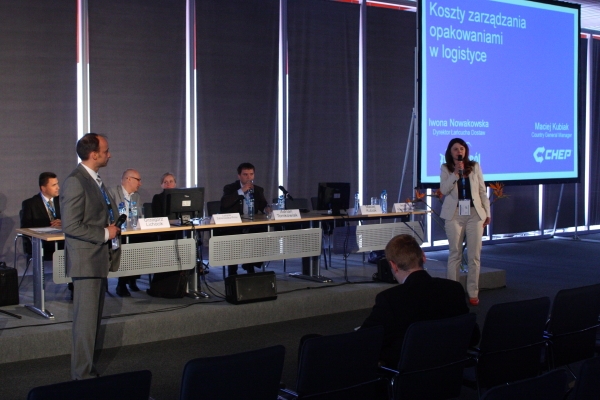
The afternoon sessions of the LOGISTICS 2012 Congress were primarily devoted to supply chain issues and innovations in transport. Changing market conditions over the last 5 years have forced companies, in order to function on the market and, more importantly, to grow and generate expected profits, to seek changes in their current operations, especially in transport.
The importance of efficient organization of transport processes in a company is confirmed by analyses conducted by European research consortia, which indicated that transport costs often account for more than 50% of total logistics costs. Additionally, companies increasingly aware of the social impact of their activities are looking for innovative solutions consistent with the concept of sustainable development. This idea was reflected in the presentation by Norbert Ołtarzewski from Bakalland SA.
– Our company is organizing a new model of intermodal transport – explains Norbert Ołtarzewski. – The first stage is the transport of a container on wheels from the plantation to the port (e.g., in Bangkok), then sea transport from Bangkok to Gdańsk, and road transport of the container from the port to the deconsolidation warehouse. The empty container is returned to the port, and the already palletized goods are transported by road from the deconsolidation warehouse to Janów Podlaski.
The main reasons for remodeling the transport previously used by the company are the expansion of infrastructure in Polish ports, the creation of new direct ocean connections to Polish ports, and the lack of necessity to organize a customs zone in the Bakalland warehouse.
– In this way, we managed to shorten the total delivery time to 7 days and unblock ramps and operational space in the Bakalland warehouse – adds N. Ołtarzewski.
A representative of UPS Polska Sp. z o.o. spoke about the benefits of using return services:
– When managing the returns process, control and efficiency are becoming increasingly important. UPS constantly monitors the quality of services and improves them – says Grzegorz Kochman, Commercial Director at UPS Polska. – The UPS network allows for ordering a return shipment from over 135 countries; the UPS return services package provides a high level of control, allowing you to adjust its level to your own needs. Importantly – UPS technological solutions can be applied to the entire package of return services.
The next session on supply chains was devoted to the most demanding industry in terms of logistics requirements – pharmaceuticals. Logistics solutions in this industry are, after FMCG, the most susceptible to the implementation of the latest solutions of the broadly understood electronic economy. At the same time, introducing improvements through, for example, the use of automatic and electronic data exchange systems is conditioned by national regulations.
– Pharmaceutical distribution experienced very strong fluctuations at the turn of the year due to the confusion caused by the announcement of new legal regulations – this is how Marcin Gawroński, Director for Pharmacies, Wholesalers, and Hospitals at IMS Poland, and at the same time the moderator of the pharmaceutical session, began his speech. – Before January 1st, we saw panic buying by patients due to the introduction of new drug lists and huge discrepancies between facts and declarations. Just after the New Year, we witnessed protests by doctors and pharmacists. All this translated into panic buying in December and a large decline in the pharmacy market in January.
Despite such fluctuations, it is clear that this market is developing – the number of chains and chain pharmacies is growing, and new forms of purchasing are emerging – loyalty programs, purchasing groups, etc.
– At the same time, the number of pharmacies outside of chains is falling, and the new law has clearly lowered the average purchases of pharmacies involved in “penny” promotions – adds M. Gawroński.
In another presentation, Violetta Suwałowska, Director of the National Transport Operations Office at Farmada Transport, presented trends in pharmaceutical distribution.
– In the classic distribution model, manufacturers do not deal with the distribution of goods, often because, for example, they do not have their own vehicle fleet and warehouses. The manufacturer uses the resources of other entities involved in drug distribution, i.e., pharmaceutical wholesalers or external logistics operators – explains V. Suwałowska. – The logistics operator mainly uses one of three distribution channels: to pharmacies, to hospitals, or to a pharmaceutical wholesaler. However, a new trend has emerged where a logistics operator or wholesaler delivers drugs directly to the patient. And this form of purchasing drugs is slowly starting to become widespread.
In the session devoted to supply chain costs and controlling, moderated by Bogusław Śliwczyński, Proxy of the Director of the Institute of Logistics and Warehousing for Consulting, the speakers tried to explain how to link comprehensive analysis of market and financial results with the organization of operational activities and the shaping of company resources, as well as how to optimize the company’s balance sheet by improving the supply chain.
– One of the solutions allowing for the reduction of logistics costs is the elimination of additional domestic warehouses and replacing them with one regional Distribution Center – explains Grzegorz Lichocik, President of the Management Board of Dachser Sp. z o.o. – Of course, this results in higher transport costs, because we are moving goods away from sales markets, but you have to look deeper: we gain a reduction in storage costs, lower administrative costs, better inventory management, and thus better production and order planning. In the overall balance, we reduce the costs of running the company.
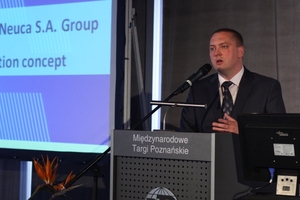
After the break, during which Congress participants could visit the “Logistics Market 2012” exhibition, the second plenary session began, during which the winning project in the Polish Logistics Association 2012 award competition was presented. In this edition of the LOGISTICS 2012 Congress, the presentation titled “Coordination of transport processes in companies of the Neuca SA capital group based on the concept of sustainable development”, presented by Dariusz Łukawczyk, Director of the Central Transport Department at the Neuca Group, won.
– The goal of the project was to develop a model for coordinating transport processes in eighteen pharmaceutical companies belonging to the Neuca capital group. The task of the model was to reduce transport costs, thanks to the achieved synergy effect. However, due to challenges on a macro scale, it was also necessary to ensure the company’s effective and efficient functioning in the long term – said D. Łukawczyk.
Today, 4 logistics workshops are still being held at the headquarters of the Institute of Logistics and Warehousing: Warehouse management based on IT support, Group purchasing of transport services, Analysis and assessment of inventory management using IT tools, Safe product on the market – a priority for food producers and distributors, conducted by specialists from the Institute of Logistics and Warehousing.
Here are all the presentations given at the three afternoon sessions:
Innovative solutions in transport:
– Terminal operator as an element of global supply chain solutions (DCT Gdańsk SA)
– Intermodal transport in FMCG (BAKALLAND SA)
– Reverse logistics – an effective returns process as a business development tool (UPS Polska Sp. z o.o.)
– Autoroutes Ferroviaires services (Lorry Rail Luxembourg)
– Coordination of transport processes in Neuca group companies based on the concept of sustainable development (Neuca SA)
– Optimization of deliveries in intermodal transport corridors (Institute of Logistics and Warehousing)
Supply chains in the pharmaceutical industry – problems, solutions:
– New challenges in pharmaceutical logistics (IMS Poland)
– How to effectively implement good practices in logistics (POLPHARMA SA)
– Industry aspects of implementing an EDI solution in communication with recipients (USP Zdrowie Sp. z o.o., SI Consulting SA)
– Trends in pharmaceutical distribution – sustainable development of the distribution network (Farmada Transport Sp. z o.o.)
Supply chain costs and controlling – tools, implementations, effects:
– Costs and controlling of the outbound process (Nivea Polska Sp. z o.o.)
– Optimization of the company’s balance sheet by improving the supply chain (Dachser Sp. z o.o.)
– Use of standard costing to measure the effectiveness of resource management (AMICA Wronki SA)
– Costs of packaging management in logistics on the example of wooden pallets (Chep Polska Sp. z o.o.)