The first day of the LOGISTICS 2012 Congress is already behind us. Yesterday, we had the opportunity to listen to presentations by Grzegorz Szyszka, Director of the Institute of Logistics and Warehousing; Hans Christian Pfohl, Professor at the Technical University of Darmstadt; Janusz Górski, CEO of Schenker Sp. z o.o., and Monika Pachniak-Radzińska, Business Development Director at Schenker Sp. z o.o.; and John Keogh, Director of Product and Consumer Safety at GS1 Global Office. In their presentations, they addressed both the challenges facing logistics and the solutions to them, stemming from the need for sustainable economic development. Immediately after the plenary session, Congress participants took part in a debate dedicated to the main theme of this year’s Congress: “sustainable logistics.”
So, what exactly is this “sustainable logistics”? It is primarily about initiatives and actions resulting from a common understanding of the need to consider the necessity of rational management of natural resources when defining one’s own business goals, as well as recognizing social needs and conditions (including broadly understood safety) as key priorities. Sustainable logistics is not just about meeting the expectations and requirements imposed, for example, by European Union regulations, but above all, it is a natural direction for the development of every enterprise that wants to compete in the local or global market in a responsible and forward-looking manner.
Grzegorz Szyszka, Director of the Institute of Logistics and Warehousing, mentioned this during his presentation of the report on the state of Polish logistics, adding that our country faces major challenges related to creating a sustainable logistics system.
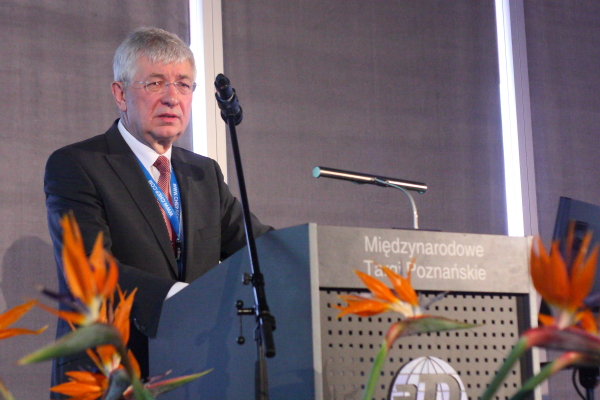 – For our enterprises to become logistically efficient, the following conditions must be met: it is necessary to improve service profitability, leading to the neutralization of cost increases and, in the next step, to greater flexibility in customer service. It is essential to create frameworks for cooperation between suppliers and recipients to eliminate empty transport runs, as well as to continue the widespread implementation of global standards to improve communication between market players – G. Szyszka concluded his speech.
Professor Hans Christian Pfohl presented his opinions in a similar tone, discussing issues related to “lean” logistics as an emerging global trend.
– The primary goal of Lean Management is to increase efficiency by eliminating waste in business processes – said H. Ch. Pfohl. – Efficiency means performing tasks properly, leading to much more focused processes, fewer unnecessary activities, and reduced resource consumption.
More importantly, Lean Management, as understood by Professor Pfohl, is largely dependent on people themselves (the so-called soft factors).
– The greatest impact on the success of “leaning” logistics comes from employee engagement and their readiness for change. Employees know the flaws and inefficient processes best, which is why Lean Management uses teamwork and employee experience to continuously improve quality and eliminate waste – concluded Professor Pfohl.
Considering social and environmental conditions should not only mean limiting the negative effects of logistics activities but should also result in solutions that improve work comfort, as could be seen during the presentation on sustainable development at DB Schenker.
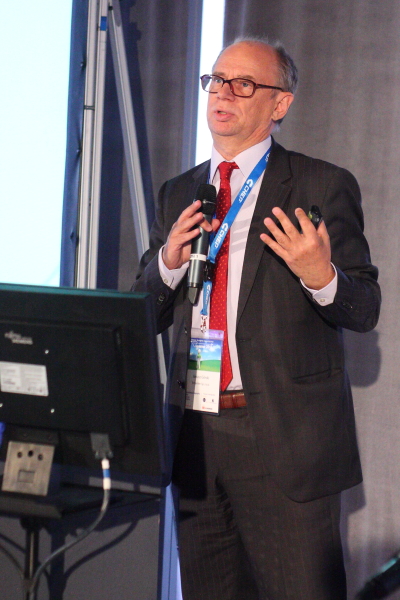
– At Schenker, we attach great importance to sustainable development throughout the entire supply chain and to responsibility in our dealings with stakeholders – said Janusz Górski, CEO of Schenker Sp. z o.o. – In all areas (social engagement, promoting and implementing eco-friendly solutions), we ensure that they translate into the satisfaction of employees and our partner companies, thereby positively impacting financial results.
After a short break, during which Congress participants had the opportunity to talk with speakers and visit the “Logistics Market 2012” exhibition, the guests’ attention was drawn to the speech by John Keogh, Director of Product and Consumer Safety at GS1 Global Office. His presentation titled “Supply Chain Security” made us aware of the gigantic scale of product counterfeiting worldwide.
– The counterfeit market is growing by 15% annually (in some years even by 22%). By 2015, the annual turnover of such goods will reach 960 billion dollars – said J. Keogh. – G20 countries lose 77.5 billion dollars in tax revenue annually due to this practice.
Financial losses are just one of the consequences of the counterfeit trade. We must remember that there are other effects, much more striking to our imagination. Counterfeits are usually very low-quality goods, made of toxic materials and substances, produced without adhering to safety standards or any quality norms. According to data presented by J. Keogh, such counterfeits contribute to the deaths of approximately 3,000 people annually, not counting those who have permanently lost their health. The growing counterfeit market also leads to an increase in unemployment (it is estimated that about 2.5 million people worldwide have already lost their jobs for this reason).
– The solution to this problem is the widespread use of GS1 standards, which enable full product traceability in the supply chain – explained J. Keogh, presenting detailed diagrams for conducting such control and explaining the benefits that not only individual companies but also entire communities will be able to achieve.
In the second half of the day, LOGISTICS 2012 Congress participants took part in three thematic sessions dedicated to logistics services, information and communication technologies in supply chains, and challenges in the retail sector, where presentations were given by companies such as Berlin Brandenburg Airport, Dachser, DB Schenker, DHL, Raben, PSI, Bluegreen SRL, PTV, JMD, SA2 PL, Comarch, and the Institute of Logistics and Warehousing.
This year’s Congress, which is traditionally organized by the Institute of Logistics and Warehousing in the pavilions of the Poznań International Fair, is the eleventh edition of this extremely popular logistics event. The event takes place every two years, starting from 1992, and in each subsequent edition, it enjoys increasing interest and engagement from speakers.
Today is the second day of LOGISTICS 2012, during which sessions will be held on technological innovations in warehousing, innovations in transport and IT, problems and solutions used in supply chains in the automotive and pharmaceutical industries, as well as costs and supply chain controlling. We cordially invite Congress participants to the aforementioned sessions, and readers of the Logistyka.net.pl portal to familiarize themselves with the reports that will appear after the Congress concludes.
Speakers who participated in the plenary session:
| Logistics in Poland 2011 | |
|
|
Grzegorz Szyszka – Director of the Institute of Logistics and Warehousing |
| Director of the Institute of Logistics and Warehousing, President of GS1 Poland, founder and long-time Chairman of the Polish Logistics Society. Initiator of the establishment of the College of Logistics, member of the Senate of this university. Chairman of the Logistics in Transport Section of the Transport Committee of the Polish Academy of Sciences. Author of numerous publications in the field of logistics systems. Co-editor of reports on the state of logistics in Poland, developed every 2 years by the Institute. | |
| Lean and sustainable logistics beyond economic benefits | |
|
|
Hans-Christian Pfohl – TU Darmstadt, European Logistics Association |
| Professor Dr. Dr. h.c. Hans-Christian Pfohl was born on March 14, 1942, in Gablonz. In 1968, he graduated from the Technical University of Darmstadt, where he studied Business Management and Mechanical Engineering. He also obtained his doctorate there. From 1975 to 1982, he headed the Department of Business Administration at the University of Essen. From 1982 to 2011, he headed the Department of Management and Logistics at the Technical University of Darmstadt. Since 2011, he has been responsible for the “Supply Chain and Network Management” program at the Faculty of Law and Economics. He also serves as deputy spokesperson for the interdisciplinary project “Dynamo PLV” (production, logistics, traffic). He also heads the interdisciplinary committee for air traffic at the Technical University of Darmstadt. Since 2000, he has been a professor at the Sino-German postgraduate school in Shanghai, where he is responsible for the “Management and Logistics” program. In 1996, Prof. Pfohl received an honorary doctorate from the University of Pannonia in Veszprém (Hungary). He gives guest lectures there on international management. In 2011, he was awarded the Order of Merit by the Government of Hesse. The main areas of Prof. Pfohl’s scientific interests (besides general management) are: logistics and supply chain management, in which he has made a significant contribution by developing new concepts. Prof. Pfohl actively cooperates with companies in all sectors, carrying out consulting projects and conducting applied research for them. Prof. Pfohl is the Chairman of the Research and Development Committee of the European Logistics Association and a member of the Board of this organization. He is also a member of the Editorial Boards of the scientific journals “Logistics Research” and “The International Journal of Logistics Management”. Two of Prof. Pfohl’s books, “Logistics Systems” and “Logistics Management”, have been published in Poland by the Institute of Logistics and Warehousing. | |
| Sustainable development at DB Schenker | |
|
|
Janusz Górski, Schenker sp. z o.o. |
| CEO of Schenker sp. z o.o. since December 2004. From 1993 to 2004, CEO of Spedpol. Within 2 years, after the merger of Spedpol and Schenker, he transformed the company into a global logistics operator, a leader on the Polish market. In the 1990s, he led the transformation of the domestic freight forwarding company Spedpol into a market logistics player, a leader at the European level. He worked at Pekaes and the private company Rundine Ruffoni. | |
| Security in supply chains |
|
|
|
John Keogh – GS1 Global Office |
| GS1 Director of Product and Consumer Safety. These activities – implemented on a global scale – focus on the use of global standards for product identification and traceability, effective withdrawal of dangerous products from the market, as well as strategies to combat counterfeit trade and prevent theft in supply chains. John Keogh advises government and intergovernmental agencies, as well as companies, in these areas. His competencies also include advising on ways to improve food safety, as well as reducing food waste in supply chains based on the use of global standards and solutions. His over thirty years of experience include leadership roles in supply chain management, information technology management, consulting, and work for global standards. He currently advises and cooperates with the European Commission, the Directorate-General for Health and Consumers, and – among others – organizations such as: OECD, APEC-ABAC, WHO, CODEX. He also participates in the work of ISO working groups dealing with the development of standards for product safety, their withdrawal from the market, combating counterfeit trade, and food safety and traceability. |
|
| Sustainable logistics – what does it mean in practice – DEBATE | |
|
|
Moderator: Sławomir Jeneralski |
| Has experience as a television and radio journalist. He specialized especially in current affairs and news. A specialist in internal and external corporate communication. He also advises companies on creating strategies in this area. Other areas of Sławomir Jeneralski’s competence include: conducting negotiations, information management, and image building. | |
|
Discussants:
Jos Marinus, Janusz Górski, John Keogh, Danuta Kisperska- Moroń |
|