










The development of the logistics and distribution function in the modern energy market results not only from its specific role in the growth of trade exchange and economic globalization, but also from trends manifested in modern corporate strategies focused on managing entire supply chains and the superior role of time in contemporary management. Competitiveness and innovation are phenomena particularly important in the development of the logistics and distribution function. Smart grids represent a unique area where environmental protection goes hand in hand with innovation and increased competitiveness. Smart grids are comprehensive energy solutions that allow for the connection, mutual communication, and optimal control of previously distributed elements of energy networks, serving to reduce energy demand. The author seeks an answer to the question: what impact will the launch of these networks have on logistics? Implementing new technologies in the field of automation, telecommunications, and IT in power, gas, or heating companies is a great opportunity for a market breakthrough. On the other hand, will the benefits of using such solutions outweigh the costs of their implementation? Will the automation of energy system control contribute to savings in logistics systems?
The global energy sector, crucial for the competitiveness of the world economy, is in a period of unprecedented change. The rapid increase in energy demand in developing countries will be the dominant factor influencing market development. The necessity of energy in all economic processes and consumption, which makes it a “public good,” determines that the rationalization of the costs of its production and physical delivery is a strategic challenge for the economy of every country. Improving the efficiency of the energy sector should result in a relative reduction in energy prices while maintaining the certainty and security of its supply. Nevertheless, experts also speak of “brakes” on the development of the energy market. Experiences of, among others, European countries (Italy, Germany, Norway), which are radically reforming their energy sectors, prove that the most effective way to force efficiency improvements is the implementation of modern technologies.
The strategic role of IT
The growing role of information in the modern economy has been recognized by virtually everyone, both practitioners and management theorists (Figure 1). For many years, there has been a discussion about the strategic role of information technology (IT) in a company. In the literature, one can find many examples of companies that have managed to gain a competitive advantage through the innovative use of IT. The opinion about the strategic role of IT and its key importance in creating a sustainable competitive advantage has become widely accepted. It is a fact that the progress taking place in the IT area is one of the main factors of change in the energy sector.
Changes in the energy market affect the following IT solutions:
-
rapid growth in energy demand,
-
development of smart grids,
-
automation of metering, electricity consumption management,
-
increasing energy efficiency,
-
liberalization of the electricity market,
-
unification of the European high-voltage energy network,
-
popularization of renewable energy sources.
The modern energy sector is characterized by an increasing pace of changes in technology, products, markets, and entire industries. Managers are forced to make decisions under conditions of growing uncertainty. One of the sources of this uncertainty is the intensifying process of redefining industry boundaries, one of the causes of which is precisely IT.
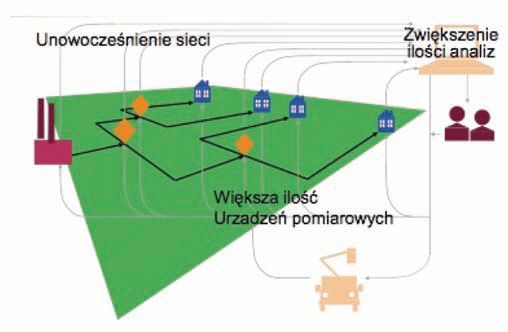
As it develops, IT is perceived by companies as an important source of success. It would be difficult to imagine, for example, the implementation of modern management methods or revolutions in energy consumption metering without support from IT. However, only those resources characterized by innovation can be considered a strategic source of sustainable competitive advantage. Examples of such solutions are technologies supporting modern billing systems (Figure 2). In summary, it is worth emphasizing that the mere fact of possessing IT should be perceived by companies today not as a source of competitive advantage, but as a competitive necessity in a globalizing market.
The article comes from the magazine “Logistyka” 4/2011.