










Although there is no shortage of universal solutions in the warehouse infrastructure market, increasing emphasis is being placed on adapting equipment specifications to the needs of specific industries. Specialized technologies and tailored modifications are designed to meet specific requirements and working conditions, further streamlining the logistics processes within a company.
The variety of goods transported in a warehouse and the storage strategies adopted are vast, so it is no surprise that expectations regarding logistics solutions also differ. Equipment must not only fulfill specific functions but also be adapted to the conditions prevailing in the storage area: from extreme temperature fluctuations to uneven surfaces. With the needs of individual industries in mind, dedicated solutions are being created.
Durability for industry
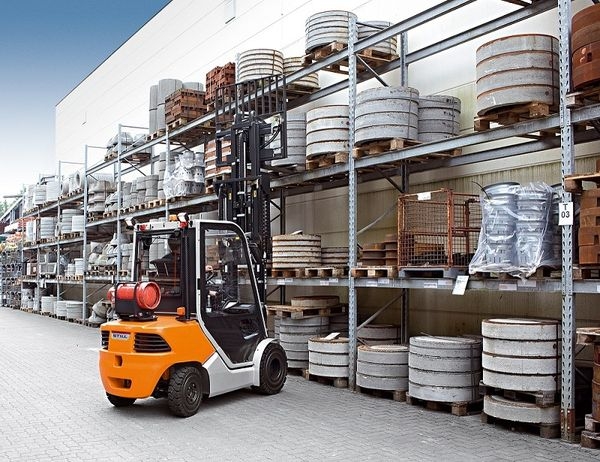
Industry puts warehouse equipment to the toughest test. The metallurgical industry, where forklifts are exposed to heavy loads, high temperatures, and mechanical damage, forces suppliers to expand their offerings with solutions such as dust protection for actuators or additional shields against metal splashes. Primarily, counterbalanced forklifts with increased maximum load capacity are used here, equipped with additional attachments such as palletizers, rotators, or clamps if necessary. Solutions for industry must be adapted to the type of transported goods and their storage conditions. For example, in the timber industry, where long-dimension loads are stored, side loaders and cantilever racking are often used. If goods are stored outdoors, as is the case in wood drying facilities, for example, it is also necessary to roof the storage area and use equipment designed for outdoor operation.
– Forklifts for outdoor use should have larger than standard wheels and high ground clearance – says Przemysław Wlazeł from STILL Polska – Such solutions increase operator comfort and allow for efficient vehicle maneuvering on uneven surfaces. Models equipped with hybrid engines, which are characterized by high durability, are also a good choice.
Sterility for the food industry
Internal combustion engines, on the other hand, are not used in the food industry. Due to the lack of exhaust emissions, only electric forklifts are used for food transport. As in many industries, solutions dedicated specifically to the food sector are used here as well. Key technologies, for instance in fish processing, are anti-corrosion measures. The use of stainless steel protects equipment during contact with salt, alkalis, or acids. Forklifts are also equipped with rollers and bearings with increased corrosion resistance, transmission and hydraulic oil adapted to sub-zero temperatures, or dedicated lubricants. In the case of the cold storage industry, where equipment is exposed to large temperature fluctuations and operation in conditions below -30 degrees Celsius, it is crucial to equip forklifts with a heated operator cabin and adapt component durability to the prevailing conditions.
Flexibility for retail
As the offerings of retail chains and supermarkets expand, their equipment needs become more diverse. The necessity of holding small quantities of a varied assortment means that full-pallet unit storage takes place at higher levels of the warehouse. High-bay racking is used here, serviced by system trucks with fork reaches of up to 5 m. In such conditions, systems supporting their operation (e.g., cameras placed on the fork tips or height programmers) and technologies optimizing the location of goods with different rotation rates are of key importance. Within the stores themselves, low-lift pallet trucks are mainly used. Here, agile, mobile, and ergonomic equipment takes the lead. Ease of operation is a very important criterion in an industry where there is high staff turnover and specific qualifications or licenses are not required. A strong emphasis on supply continuity makes retail attach such great importance to equipment reliability. This is ensured by special full-service contracts, which not only include the assumption of responsibility for the technical condition of the machines by an external company but also a guarantee of providing a replacement device during any necessary repairs.