










– The “Internship as a Scientist’s Success” (SSN) project is a unique opportunity to put into practice the knowledge that academic staff have acquired at a university or research unit. Participation in the project enables scientists to complete an internship at a selected micro, small, or medium-sized enterprise in the Greater Poland region. The internship can last from 1 to 6 months. During this time, the intern is obliged to work 120 hours for the benefit of the enterprise. The entrepreneur does not incur any expenses, as the intern’s remuneration is fully financed by European Union funds – explains Ewa Sadoch from the Poznań Academic Business Incubator, the initiator of the venture.
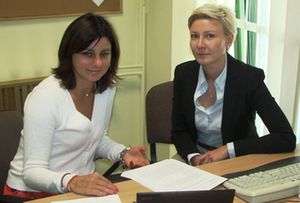
120 applications were submitted for the competition, from which 60 interns were selected – including Joanna Lewandowska and Justyna Lewandowska, teaching staff at the Poznań School of Logistics.
– This is a huge honor for us. The goal of the internship will be to develop a tool for the micro-enterprise DARLOG. We want to improve the effectiveness of conducting occupational health and safety training in warehouses – says Joanna Lewandowska, co-author of the project. – We want to develop training material entitled “Operating instructions for warehouse racks according to the updated standard EEN-PN 15635:2010”, implemented in the form of e-learning. Thanks to the use of the e-coach version, companies will be able to manage a small number of employees more efficiently, while at the same time offering their clients broader, less expensive access to training. The benefit for WSL students will undoubtedly be active participation in our research. As potential employees in the TSL industry, our students have the chance to present their expectations regarding the training tool being created, and in a later phase of the project implementation, its evaluation. In the future, the use of modern teaching techniques will also contribute to improving students’ qualifications and will make knowledge faster and easier for them to absorb.
– In general, this project will allow for the realization of a number of additional goals in the social, educational, and scientific layers. A kind of knowledge logistics will take place here, consisting of the mutual transfer of knowledge, from scientists/lecturers to the micro-enterprise, and further to potential trainees, i.e., clients/students – adds Justyna Lewandowska, co-author of the project.
The introduction of the improved training process will consist of three stages. First, the e-coach system will be made available to companies that express a desire to train their employees in the field of OHS in warehouses. The training will be sent electronically or will be available for download from the DARLOG company website. Thanks to this, candidates can absorb the knowledge before proceeding to the next stage – that is, verification. Verification takes place by solving a test developed in an electronic version. After receiving a positive test result, in the third stage, the trainee receives a certificate.
To illustrate the benefits of the modern training method, the project authors conducted simulations, which show that after the introduction of e-coach training, there will be an increase – by nearly 42% – in the employee’s working time for the micro-enterprise, excluding the time spent on organizing training.
– The simulation perfectly reflects the benefits for the micro-enterprise in the form of more effective personnel management. Thanks to the fact that the content of the training modules is in the e-coach version, they can be used both by companies commissioning training and by companies involved in organizing them, regardless of the business profile and industry – says Justyna Lewandowska.
Ms. Ewa Sadoch, coordinator of the SSN project, emphasizes that all improvements that academic staff have brought to companies in the previous two cycles of the program are usually permanently implemented in the enterprises.
– The project enjoys great interest from both academic staff and entrepreneurs. In the previous two internship cycles, there were twice as many applicants as there were places for them. Interns work on innovations in fields such as: 3D technologies, genetics, robotics, acoustics, surface physical chemistry, or quality systems – claims Ewa Socha.
This year’s internship began on September 1, 2011, and will last for six months.