










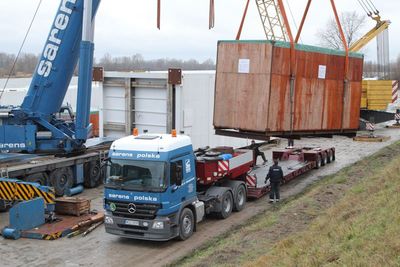
Air Liquide Polska, the direct recipient of the installations, decided to entrust the project to DHL Global Forwarding due to the documented references of the company’s Industrial Projects Department and DHL’s extensive experience in transporting oversized cargo. The project involved transporting components from the port of Shanghai to the Zakłady Azotowe Puławy site. DHL Global Forwarding acted as the coordinator, providing the necessary know-how, planning, directly organizing, and supervising every phase of the project, which was carried out in two stages. In the first stage, the oxygen plant components, the largest of which weighed over 160 tons, were transported along the Vistula River from the port of Gdańsk to a quay near Puławy. Subsequently, using specialized vehicle sets, they were transported to the Zakłady Azotowe site in Puławy. The next stage, which included the transport of components for the second plant, began with the loading of over 130 installation components onto a ship in Shanghai. After the cargo arrived in Gdańsk, key components were reloaded onto barges and delivered to the quay near Puławy. Due to unfavorable weather conditions and ice floes covering the Vistula, some of the installation components are still waiting to be reloaded onto trucks.
– The time of year during which the project for Air Liquide Polska was implemented forced the Industrial Projects Department team dedicated to its execution to be fully flexible – said Piotr Iwaniuk, CEO of DHL Global Forwarding – Thanks to our experience and top-tier logistical and organizational skills, the project was almost entirely completed, despite decidedly unfavorable meteorological conditions.
Every possible means of transport, with the exception of air freight, was involved in the implementation of both stages of the project. In addition to chartering 2 ships and 14 pontoons and barges, it was necessary to organize 30 standard tarpaulin trucks and 20 special vehicles for transporting oversized cargo directly from the port to Puławy. Meanwhile, containerized cargo was delivered by rail transport.