








The article participated in the 4th edition of the “Pen of the Logistician” competition.
This article presents a method of goods identification that helps integrate the broadly defined logistics network. It introduces improvements that contribute to the enhancement of provided services, and consequently, to increasing the satisfaction of both internal and external customers. The presented ePC technology, which utilizes Radio Frequency Identification (RFID), creates new possibilities and may contribute to a major revolution, comparable to Just-In-Time. RFID has been known for many years and used in various fields. However, these were expensive solutions that prevented mass application. This situation has changed due to progress in the field of microelectronics. Mass-produced and therefore cheap, miniature electronic circuits have a small size and thickness, which allows them to be placed in self-adhesive labels and identification cards. This makes the technology likely to become very popular in the near future.
1. RADIO FREQUENCY IDENTIFICATION
RFID (Radio Frequency Identification) refers to radio identification systems that can identify objects and transmit and store data over a distance. The operating principle of a basic RFID system is shown in Fig. 1.
RFID (Radio Frequency Identification) refers to radio identification systems that can identify objects and transmit and store data over a distance. The operating principle of a basic RFID system is shown in Fig. 1.
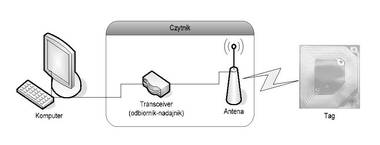
Fig. 1. Basic RFID system.
Source: Own elaboration.
Source: Own elaboration.
It consists of three elements: a tag, an antenna, and a transceiver with a decoder, which are described below.
The tag is made of thin paper or plastic, most often self-adhesive. On its surface, a transceiver antenna path and a tiny electronic circuit are applied, from which information can be read via radio waves. A photo of a tag is attached next to this. There are several types of such labels. Depending on the needs, there are read-write or read-only tags. One can use so-called passive or active RFID labels. Passive ones are those that do not have their own power source but use the energy of the radio signal used to read the label. Active ones, on the other hand, have their own power supply, but their price is significantly higher. We also distinguish tags that have memory (memory tags) or a processor and memory (processor tags).
The antenna is integrated with the transceiver and decoder in one housing. It emits radio signals to activate the tag and to read and write data to it. The antenna is connected to the transceiver, which is responsible for data acquisition and communication. Depending on the needs, it can have various shapes and sizes; it can be, for example, built into a door frame to detect the movement of people and goods, or mounted on a boom to monitor vehicle passage, or it can be built into a portable terminal for, e.g., inventory taking. The electromagnetic field can be emitted by the antenna continuously when communication with many tags is expected in a short period of time. If continuous emission is not required, the field can be switched on by an additional sensor.
The reader emits radio waves with a range from a few centimeters to several dozen meters or more, depending on the output power and the radio frequency used. Most often, the reader is built from a modulator/demodulator circuit, a microprocessor, memory, and an antenna or antennas (transceiver). The reader is responsible for sending information to the tag, reading and decoding the data received from the tag, and sending it to a computer for further processing.
RFID systems have a distinct advantage over barcode systems. Tags are read in a contactless manner, even from significant distances, and there is no need for the reading device to have a direct line of sight to the tag – they can be read in diverse environments, e.g., through snow, ice, paint, dust, dirt, which is not always possible in the case of barcode technology. Tags can be read at very high movement speeds and can also be read “simultaneously” in anti-collision mode. An important feature is also the ability to write to the tag’s memory, which significantly expands the scope of RFID technology applications.
These systems operate in several radio frequency ranges. Historically, the oldest is the 125-134 (<135) kHz band; slightly later, chips operating in the UHF (868-956 MHz) ranges and microwave circuits (2.45 GHz) appeared. Each country has its own regulations regarding the allocation of frequencies in which RFID transmitters operate. The most widespread in the world are <135 KHz and 13.56 MHz. Tags operating at the 13.56 MHz frequency can store up to 2 KB of data, almost 30 times more than those adapted to the <135 KHz frequency. It is likely that by 2010, standard data exchange frequencies will be introduced worldwide.